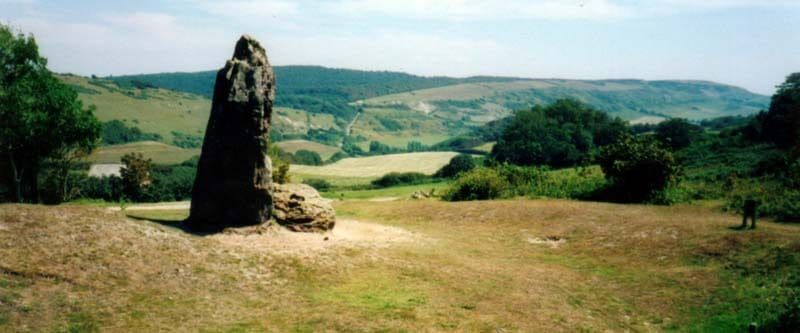
Seen in isolation, the oldest human-made structure on the Isle of Wight, Mottistone's Longstone is an unsolvable mystery. Viewed in a landscape context, it becomes part of a giant timepiece.
The Longstone
The ‘Longstone’ is believed to be part of the remains of a dolmen burial chamber currently dated to the BC 3000s – coincidental with the time of the Old Kingdom of Egypt, the era of the Great Pyramids’ construction.
Relics and remains found in undisturbed dolmens elsewhere suggest that those who built them were experienced in agriculture, pasturage, and civil engineering. Preservation of particular bones such as skulls and evidence of repeated movement suggests these may have been part of religious ceremony, not fun and games.
Today, the Longstone seems isolated in a familiar Back-of-the-Wight landscape adjacent to Strawberry Lane. A lonely megalith stood upright like the only remaining tooth in an unknown fossil.
Why is the Longstone Where it is?
Step back 5000 years and context and meaning might return. Nothing has changed, the geography is exactly the same: the placed stone might be less weathered, the stone beside it may be upright and other megaliths are present.
The ridge above the monument runs the same direction, roughly north to south; the Sun still rises above it.
One important difference may have been the ridge itself. Today only a chain of prehistoric barrows survives. Five thousand years ago those burial mounds would have been newly raised, prominent features upon the skyline.
Put these facts together and something comes into focus.
You do not see an isolated stone. You see a sacred landscape.
The Longstone below; the ridge above; the mounds on the skyline. From the western side of the Isle of Wight, particularly viewed from the heights of Tennyson Down, the rising sun appears to travel steadily along the ridge through the year.
In summer it rises far to one side of the skyline. As autumn advances the point of sunrise shifts day by day until winter brings dawn from a markedly different position.
Placement of the Barrows
The ridge functions almost like a natural calendar. Anyone living beneath it could track the progress of the seasons simply by watching where the sun emerged.
The barrows cease to look like isolated archaeological features. They begin to resemble markers within that calendar-like landscape. This invites new questions about the Longstone.
Were the barrows deliberately positioned along this solar route? Did the movement of the sun connect the ancestors buried on the ridge with the monument below?
Was the Longstone part of a ceremonial processional route between the living and the dead?
Why were the ancestors placed upon the skyline? In many prehistoric societies the dead underwent complex rites before their final burial. Whether the barrows served only as tombs, or formed part of a longer ceremonial journey, remains unknown.
Their elevated position suggests that the relationship between the dead, the landscape and the heavens may have been as important as the burial itself.
Maybe the Longstone is not merely a tomb; it is part of an ancient Island machine for measuring time.
A clock without gears and hands; but a clock made from light and the landscape, its hills and a cosmic-sized moving part - the sun.
Longstone Facts
The 'Longstone' is in fact two stones, of stratified iron sandstone from the lower greensand formation, the prevailing stone in this area, and probably came from Compton Bay cliff. The height of the upright stone is 3.9 m its widest side is nearly 2 m, its circumference 6.1 m.
The recumbent stone's length is 2.8 m; widest width, 1.2m.
Two forms of dolmen have been identified, the simplest were made of massive flat stones, three forming usually its three sides, the fourth side being open and a fourth flat stone for the roof.
More sophisticated dolmen structures were entirely enclosed with large stones, with a central megalith.
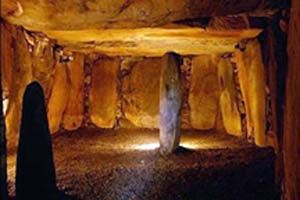
A Stone Beneath the Sun Road
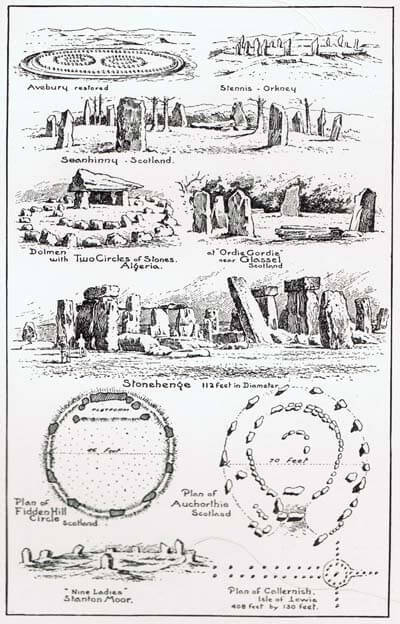
The Longstone dolmen may be connected with more famous megalithic structures in mainland Wiltshire - Stonehenge - and more distant - Giza in modern Egypt.
One 19th and early 20th century theory suggested connections between Atlantic megalith builders and North Africa.
Mythbuster T.W. Rolleston analysed Celtic legends and noted how a map of dolmen distribution "irresistibly suggests" the idea their builders were of North continental African origin, migrated westward, crossed into Europe via the Straits of Gibraltar, then spread through the western regions of Europe, including the British Isles.
The symbol of a ship and a circle above it, as if the sun, is almost identical to those used in ancient Egypt to depict the boat of Sun God Ra carrying the dead to the Otherworld. The wedge-shape design of a dolmen may represent a boat.
Not enough evidence to prove dolmen raisers and the great pyramid builders of the Nile region were of the same nation, says Rolleston but what there is points to some form of Egyptian connection. Impressive stone tomb structures and elaborate funerary rituals are not the only similarity.
 Nick Hammond
Talk Like an Egyptian
Rolleston quotes Rhys and Brynmor Jones's discovery - preserved in Welsh language is an idiomatic structure which strongly suggests a link between peoples of ancient Britain and land of the pyramids:
'The pre-Aryan idioms which still live in Welsh and Irish were derived from a language allied to the Egyptian and the Berber tongues.'
The Pharaoh's Legacy
Although the ways and beliefs of these dolmen-builders seem so lost in antiquity and mystery, what is surprising is the continuity between ancient Egyptian and Celtic druid beliefs and our own of modern times.
A priestly group still presides over funerary rites and maintains, much as the ancient Egyptians and druids did, that the soul is immortal and its ultimate journey into the realms beyond is to reunite with the deity of light.
An all-seeing, all-knowing great sky father god. The Sun.
The Longstone Mystery
More than five thousand years after it was raised, the Longstone continues to guard its secrets. Was it a simple burial chamber? A ceremonial gathering place?
No one knows.
The people who raised the Longstone are gone; their language is forgotten. Their beliefs remain uncertain. All we can say for certain is that every sunrise still climbs the ridge above Mottistone, just as it did when the monument was new.
But for those who lived here on this island so long ago the Longstone may not have stood alone in the minds of its builders.
They saw the chalk ridge of Mottistone Down, they crowned it with a chain of prehistoric burial barrows. Then as now, throughout the year the point of sunrise advances steadily along this skyline. Summer dawns break closer to the Solent, winter dawn from the sea beyond Ventnor.
The sun's journey marks the passing months with remarkable precision. To modern eyes the ridge behaves almost as a landscape clock.
Whether this relationship was intentional cannot now be proven. Yet the Longstone's position beneath the ridge invites a larger question. Perhaps the monument was never simply a tomb. Perhaps it formed part of a sacred landscape in which the dead, the living and the movements of the heavens were connected.
The builders of the great pyramids, Stonehenge and Avebury all worked on a landscape scale, combining architecture, geography and the movements of the heavens into a single design.
If so, the greatest prehistoric monument at Mottistone is so much more than this surviving stone alone. It is the stone, the ridge, the barrows and the sunlit horizon together.
Do they all participate in the same visual composition?
Was that composition intended as a calendar, an ancestral landscape, a ceremonial route, or all three at once?
The Isle of Wight's oldest mystery may never be solved. Yet every dawn still traces the same ancient pattern across the skyline, just as it did when the Longstone was new.
 Nick Hammond