The Margo Williams Clairaudient Archive
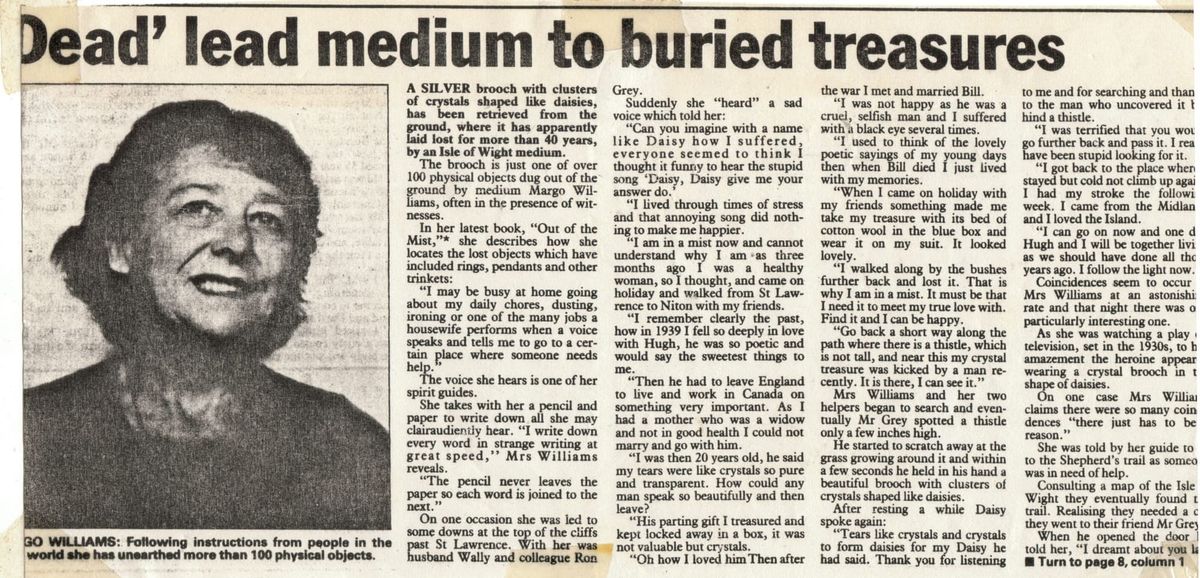
The Margo Williams clairaudient archive preserves the surviving records of one of Britain's most mysterious 20th century investigations into reported communications with the dead.
Introduction to the Archive
Conducted principally between 1976 and 2009 by Margo and Walter Williams of the Isle of Wight, this archive brings together surviving transcripts, historical research, published investigations and later case files.
Much of the later research, documentation and preservation of the collection was undertaken by Nick Hammond, who accompanied Margo Williams for seventeen years.
Whether readers interpret the material as evidence of survival after death, an unusual psychological phenomenon or an intriguing chapter in social history, the archive aims to preserve the record rather than argue for a single conclusion.
The First Communication
In the spring of 1976, an apparently ordinary house on the Isle of Wight became the centre of an extraordinary mystery.
Its occupant Margo Williams claimed that a ghost spoke to her.
It didn't arrive as a dramatic apparition, or fleeting shadow, it recited a child-like poem about her life. The speaker identified herself as a woman named Jane who had lived in Devon, a UK county on the south coast, during the 19th century.
Through the narrative of her poem she described an unhappy life, the deaths of four infant children, and events surrounding a concealed homicide. The account contained names, locations, dates and personal details.
Margo's husband Walter, a retired chemical engineer, approached the matter with scepticism. Rather than accepting the story at face value, he attempted to verify the information it contained. That information was something of a puzzle until the name of a doctor was mentioned.
That name could not be found in any available reference book, it appeared in an old list housed in the Wellcome Medical archives.
Walter could find no obvious explanation for how Margo might have known this information. Her own explanation, that she had simply written what she heard, seemed impossible to reconcile with conventional assumptions.
But what followed was extraordinary on a scale the Williamses could never have anticipated, and the world took notice.
The Communicators Multiply
The voice identifying itself as Jane did not prove to be an isolated occurrence.
According to Margo Williams, once the initial communication ceased, other voices began to arrive. They spoke over a period of days or weeks to complete their accounts.
Margo described the process not as trance mediumship but as a form of rapid dictation. She heard words, phrases and names which she wrote down as quickly as possible.
"It is like taking dictation," Margo explained. "I hear a voice and I write down what I hear."
From April 1976 until September 1977, Margo produced almost six hundred scripts attributed to thirty-one different communicators. Most claimed to have lived during the eighteenth and nineteenth centuries, although some described events from earlier periods and others appeared connected to more recent history.
The personalities who emerged formed an unexpected cross-section of society. Among them were labourers, teachers, surgeons, clergy, naturalists, military officers, housewives and public figures.
Some communicated only a handful of times. Others returned repeatedly to tell longer and more detailed stories.
For Walter Williams, the important question was not who these personalities claimed to be, but whether the information they provided could be independently verified.
Historical Verification
Unlike many accounts of mediumship, the Williams archive generated a substantial quantity of names, dates, occupations and locations that could potentially be checked against historical records.
Walter Williams approached the communications as an investigator. A trained chemist and former industrial researcher, he spent countless hours writing to archives, museums, libraries, universities and local historians throughout Britain.
Many enquiries reached dead ends. Some clues appeared impossible to verify. Yet a surprising number led to documentary records which appeared to correspond with details contained in the scripts.
Over time Walter assembled folders of correspondence, newspaper references, parish records, institutional replies and archive notes relating to the communicators.
A communicator identifying himself as Robert Young described his work as ship surgeon aboard HMS Ardent during the Battle of Camperdown in 1797. He named both the vessel and its captain, Burgess.
Walter Williams sought confirmation from naval archives. Correspondence from Greenwich confirmed the participation of HMS Ardent in the battle and identified both Captain Burgess and the ship's surgeon as Robert Young.
Case Studies
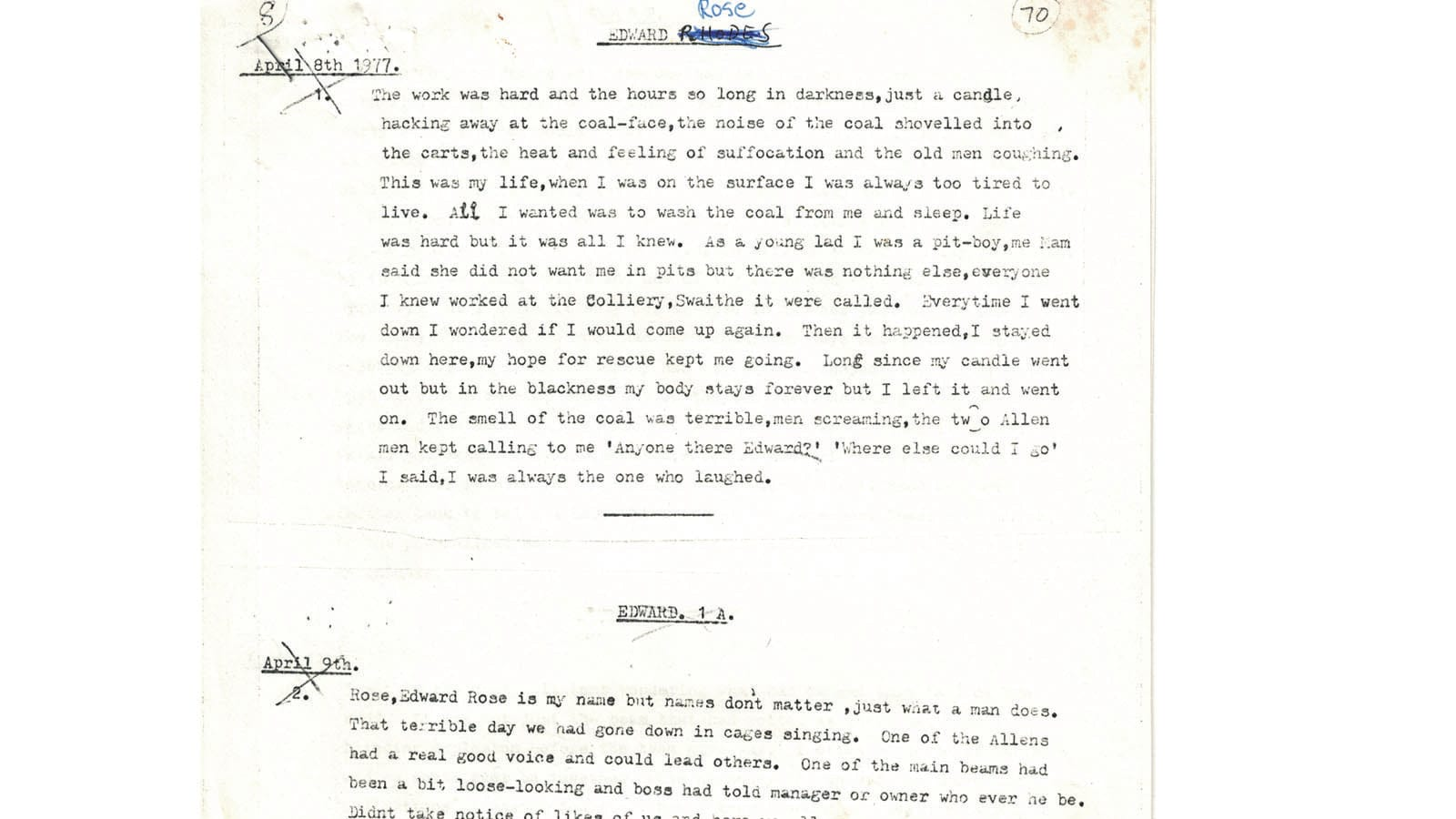
Over seven scripts, a communicator named Edward Rose described his death in an explosion at Swaithe Colliery in Yorkshire. He referred to the deaths of two young brothers among the victims.
The National Coal Board later confirmed the existence of the long-closed pit and supplied details of the 1875 disaster, including records relating to the Allen brothers mentioned in the communications.
Another communicator claimed to have been associated with the early years of Cheltenham Ladies' College. Enquiries to the school's archivist led to confirmation of Mrs Proctor's role and revealed details not easily found in standard historical accounts.
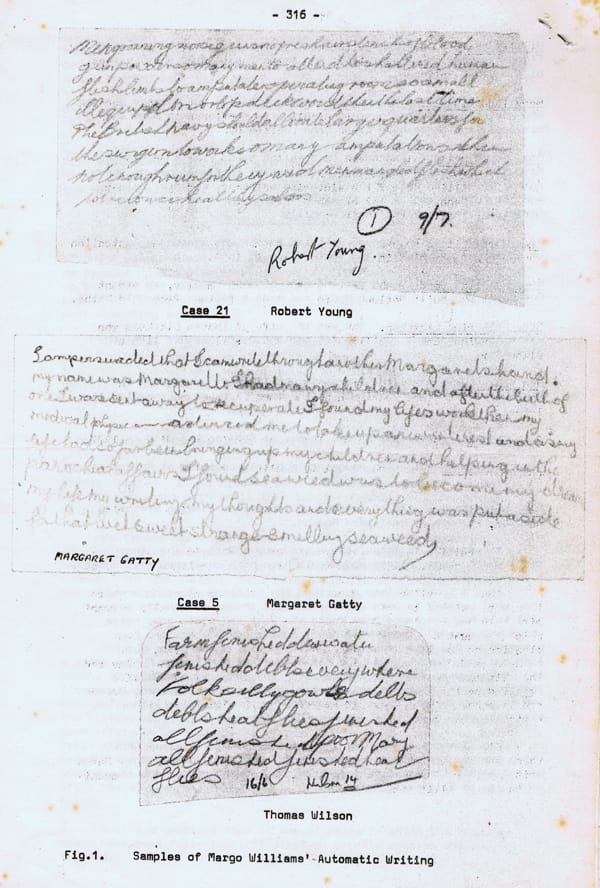
A subsequent series of scripts referred to a woman with a strong interest in marine plants and natural history. Research eventually identified the communicator as Margaret Gatty, author of History of British Seaweeds and wife of the vicar of Ecclesfield.
For the Williamses, such cases suggested that the communicators occasionally supplied information unknown to Margo herself and difficult to obtain through ordinary means.
The World Takes an Interest in the Williamses
As the number of documented cases increased, news of the Williamses' investigations began to spread beyond the Isle of Wight.
Local newspapers were among the first to report on the unusual communications and the efforts being made to verify them. National attention soon followed.
Margo and Walter Williams discussed their experiences on radio programmes, including the BBC's World at One, while articles appeared in newspapers and specialist publications concerned with psychical research and unexplained phenomena.
In September 1977 the Williamses were invited to present their findings at the Parascience Conference in London. Their paper, titled A Case of Automatism – Evidence for Survival, outlined fourteen communications and the methods used to investigate them.
The following year they returned to present Automatism, Survival and Reincarnation, describing new cases and developments arising from their continuing work.
While opinions differed regarding interpretation, the archive had clearly moved beyond a private curiosity and become a subject of wider public and academic interest.
For a brief period, a retired chemist and a clairaudient from the Isle of Wight found themselves contributing to one of the most intriguing debates in psychical research: whether human consciousness might survive bodily death.
Exploring Haunted Houses
By 1978 the focus of the Williamses' investigations expanded.
The earliest communications had arrived in the quiet surroundings of their own Isle of Wight home. Increasingly, however, reports from historic buildings, private houses and members of the public suggested that similar phenomena might be encountered elsewhere.
The Williamses began visiting locations associated with reputed hauntings and unexplained experiences.
The purpose was to discover whether communicators encountered in those locations could again provide information capable of independent verification.
Among the locations investigated were historic Isle of Wight buildings, including Appuldurcombe House, Gatcombe House and properties in the Knighton area.
In several instances communicators appeared to identify themselves by name and supplied historical details which Walter Williams attempted to trace through archives, parish records and local history sources.
What had begun as a single unexplained voice in an Isle of Wight home was evolving into a wider exploration of haunting, particularly the nature of memory and identity; and the possibility that human experience extends beyond the limits of one life.
Explore the Archive
The archive is organised into several collections. Readers can explore how Margo Williams worked; the academic investigation into the Williamses' claims; the surviving original clairaudient transcripts; and the themed collections: Heaven & Hell; Royalty & Rogues, Famous & Forgotten, Destiny & Desire and Life & Death.
The Williams Legacy
The Williams archive remains an unfinished investigation.
Some investigations produced fascinating historical correspondences. Others remain unresolved. Many raise questions that may never be answered.
Many communicators could not be identified. Some supplied too little information to permit meaningful investigation, while others remain unresolved despite extensive research.
The archive therefore contains both apparent successes and unanswered questions, reflecting the realities of historical investigation rather than a selective presentation of favourable cases.
Together they form an unusual historical record of two people attempting to test a remarkable claim: that voices claiming to belong to the dead could provide information capable of surviving critical examination.
Whether interpreted as evidence for survival after death, an unusual psychological process, or a phenomenon that remains unexplained, the Williams archive stands as one of the most ambitious attempts by an ordinary British family to investigate voices that appeared to come from beyond the boundaries of conventional experience.
The documents, transcripts and case studies preserved here tell the story of that investigation, and invite each reader to reach their own conclusions.
Continue the Investigation.
Time Anomalies
What if some hauntings are not ghosts but intersections with the past?
Isle of Wight Ghosts
The island's folklore, séances, investigations and haunted locations.
British Ghost Cases
Why Britain became the world's greatest storyteller of ghosts.
Unsolved Mysteries
Ancient monuments, lost meanings and the power of wonder.