Princess Elizabeth entered Carisbrooke Castle as a royal prisoner and died there only weeks later. Her remarkable final letter transforms a forgotten Civil War tragedy into a timeless question.
The Unsolved Mystery
Humans are arguably the most caring species that has ever existed. We spend billions helping people we will never meet. We write novels almost entirely about love. Yet the same species repeatedly wages wars and commits genocide.
How can both be true?
Love so often loses to power, yet somehow still leaves the deepest mark on history.
The Death of a Princess
Almost overlooked in the history of the English Civil War was a brief period during which Carisbrooke Castle became an unexpected experiment in human nature.
Within one generation it contained a king awaiting an execution; his children mourning his death. A staff of Parliamentary soldiers and officers convinced they were creating a better England; and ordinary servants trying to keep two frightened children alive.
The tragedy that unfolded inside the castle was not simply the death of a princess. It revealed how private love survives within public conflict.
Following the fall of King Charles I, wife Henrietta Maria and their children escaped into exile abroad. All except two, youngest son Henry and daughter Princess Elizabeth aged fourteen.
Oliver Cromwell ordered them held captive.
The decision was taken by Parliament to send them to Carisbrooke Castle, where their father was imprisoned for a year before his trial.
The children arrived during Thursday 13th August 1650, met by the new commander of the castle - Colonel William Sydenham, one of Cromwell's favoured officers, a God-fearing Puritan.
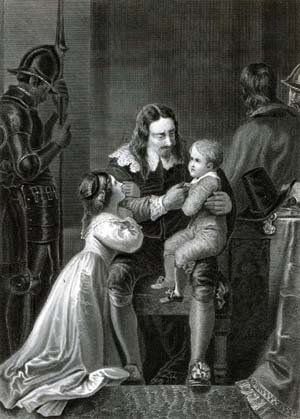
Elizabeth was clever and sensitive, Henry remained in deep shock after hearing his father's final words before execution.
The House of Commons debated on what to do with the royal captives: "Bind the boy to a good trade," suggested Cromwell. Elizabeth was to work as an apprentice to a button-maker in Newport. Henry to a shoe-maker.
Elizabeth Stuart
While imprisoned in Carisbrooke Castle Elizabeth described in writing her last sight of her father. She could have done so in different languages.
She last saw her mother years before. February 1642 the queen set out for Holland with her eldest daughter Mary, betrothed to the Prince of Orange, to raise supplies for Charles' assistance in his struggle with parliament.
Princess Elizabeth never saw her mother or sister again.
She and Henry were passed from house to house; each move accompanied by reduced allowances until Elizabeth finally arrived on the Isle of Wight already suffering from fever. And when it rained, cold and hard on the Monday after their arrival - August 19th - Sydenham's men were slow to stop play on King Charles' rain-soaked bowling green.
Next day Elizabeth complained of a headache and fever which worsened. During the first four days she was attended by Dr. Bagnell a physician from Newport, and from London Dr. Treherne sent a physician with some of his own prepared remedies. Despite all best efforts Elizabeth's condition worsened.
She passed from life alone in her room on Sunday 8th September 1650.
Who Was Princess Elizabeth?
Born in St. James' Palace London 20th January 1635 Elizabeth was the second daughter and fifth child of Charles I and Henrietta Maria.
Inherited his melancholy temperament and her delicate physicality, from early childhood years Elizabeth's constitution was not robust.
Royal physician noted: '...sad, and somewhat liable to complaints of the spleen.' When in 1640 there was a plan to engage her to the Prince of Orange, the Secretary of State wrote she might probably expire before their contract was completed.
But she was clever. 'She proved a lady of parts beyond her age,' observed Fuller, '...the quickness of her mind making recompense for the weakness of her body.' So great was her progress that before she was eight years old she could read and write five languages beside her own - Hebrew, Greek, Latin, Italian and French. She read the Scriptures in their original tongues.
Princess Elizabeth's Cause of Death
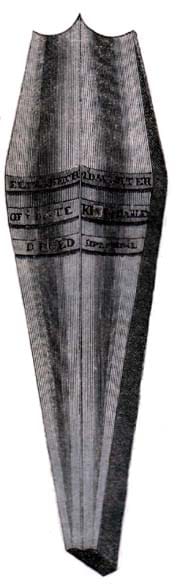
According to Sir Theodore Mayerne, summoned to help but arrived too late: "She died of a malignant fever, which constantly increased, and she being far distant from physicians and remedies."
Another account by Heath was critical:
"...The Princess Elizabeth, coming from bowls with her brother complained first of her head and having lain sick a fortnight, died. Little care was taken of her, the place affording no learned physician..."
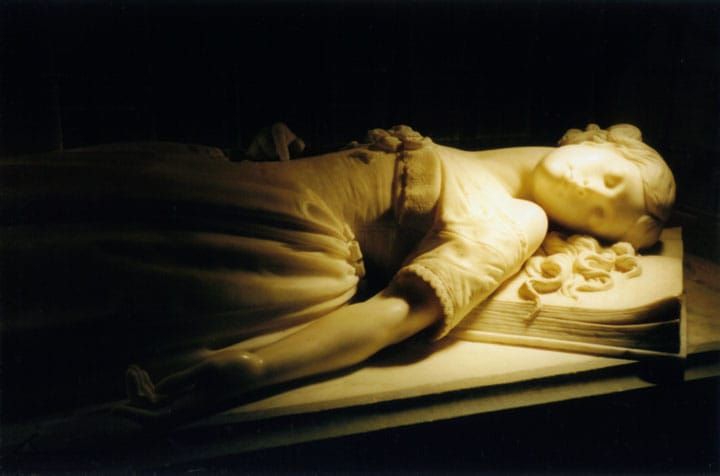
Elizabeth lay cheek resting on a Bible, the last gift from her father.
Modern examination of her remains found evidence of Rickets, a disease usually caused by vitamin D deficiency that softens the bones, and relatively unknown to English practitioners at the time. Whether this was the direct cause of her death remains uncertain.
Henry followed the borrowed coach to Newport, watched his sister's funeral. He remained imprisoned in the castle until 1652 when Cromwell permitted him to join what remained of his family in Holland.
Princess Elizabeth's Letter
During imprisonment at Carisbrooke Elizabeth wrote out her father's last words before he was taken away:
'What the king said to me 29th of January last, being the last time I had the happiness to see him,' she wrote.
"He told me that he was glad I was come, for, though he had not time to say much, yet somewhat he wished to say to me, which he could not to another, and he had feared 'the cruelty' was too great to permit his writing. 'But sweetheart,' he added, 'thou wilt forget what I tell thee.'
Then shedding an abundance of tears I told him that I would write down all he said to me. 'He wished me,' he said, 'not to grieve and torment myself for him, for it was a glorious death he should die, it being for the laws and the religion of the land.' He told me what books to read against Popery.
He said that, 'he had forgiven all his enemies, and he hoped God would forgive them also;' and he commanded us, and all the rest of my brothers and sisters, to forgive them also. Above all, he bade me tell my mother that 'his thoughts had never strayed from her, and that his love for her would be the same to the last;' withal, he commanded me and my brother to love her, and be obedient to her.
He desired me 'not to grieve for him, for he should dxe a martyr; and that he doubted not but God would restore the throne to his son, and that then we should all be happier than we could possibly have been, if he had lived;' with many other things, which I cannot remember.
His majesty also bid me send his blessing to the rest of my brothers sisters, with commendations to all his friends. So after giving me his blessing, I took my leave. Reliquae Sacrae."
Why Elizabeth's Letter Matters
Why does love so often lose to power?
Every person in this tragedy probably believed they were acting morally.
Humans are arguably the most caring species that has ever existed. We nurse premature babies; rescue strangers; cry over abandoned dogs.
Yet the same species repeatedly orders executions and builds concentration camps. How can both be true?
Poet Alfred Lord Tennyson famously described nature as "red in tooth and claw". Evolution rewards survival. Love often demands sacrifice. Seen purely through evolution, selfishness often appears to offer the better chance of survival. Yet civilisation appears built on the opposite principle.
Parents sacrifice themselves; doctors enter epidemics; firefighters enter burning buildings; soldiers throw themselves onto grenades; people donate kidneys. None of these maximise personal survival.
Love repeatedly asks people to act against immediate self-interest.
And yet..., only sometimes.
That tension is perhaps the defining tension of civilisation.
This is why Elizabeth's letter matters. It is historical evidence, but it is also evidence that at the very moment politics destroyed a family, Charles' thoughts were not revenge. They were: Forgive them.
Love your mother.
Love your brothers and sisters.
Read.
Think.
Do not hate.
Whether Charles is admired politically is a matter of choice. The emotional content is universal. Parents still say similar things today when dying.
There is every reason to believe Cromwell loved his own children. Almost certainly his soldiers loved their own families. Sydenham almost certainly believed he was serving God.
History repeatedly shows that good people can participate in systems capable of immense cruelty.
The mystery is this:
Why are children so often used by adults to continue political struggles?
Princess Elizabeth's account preserves affection not bitterness.
In this way memory resists hatred. Stories preserve love long after violence has passed into history.
The Mystery of Love and Hate
We still do not know why Parliament chose to imprison two children on the Isle of Wight. We may never know. But perhaps the larger mystery is not political at all.
Humans are capable of astonishing love. We care for children, strangers and animals with a tenderness found nowhere else in nature. Yet history repeatedly shows that compassion can be pushed aside by fear and ideology, ambition or survival.
Every generation believes it has learned this lesson.
Every generation discovers that love remains surprisingly fragile when confronted by fear, ideology or power.
Princess Elizabeth died within the walls of Carisbrooke Castle more than three and a half centuries ago. Her words survived.
Perhaps that is love's gentle victory.
Violence changes history.
Love is what history remembers.