History of Belief
Most of us are rightly occupied with living but sooner or later we all confront the same uncomfortable truth: life comes to an end. How do we know what happens after?
Five Thousand Years of Belief
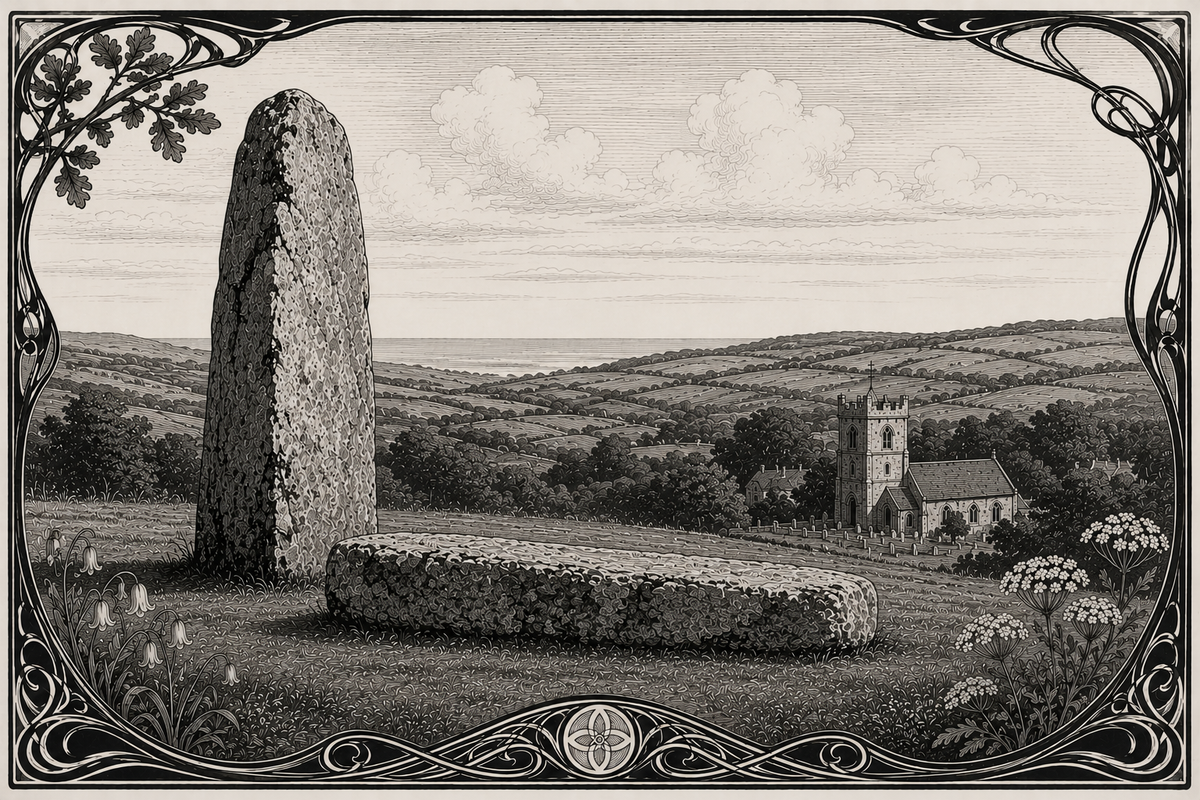
Few places on the Isle of Wight reveal Britain's changing spiritual landscape more clearly than Mottistone village. On the ridge above the village a Neolithic burial monument overlooks a medieval church. Between them lie five thousand years of changing ideas about death, the soul and the unseen world.
The monuments changed; the religions and sacred books changed. But one question has endured:
What happens when we die?
Architecture of the Afterlife
Every generation sooner or later has sought someone to explain death. Today it may be Mottistone's parish priest; two thousand years ago it might have been a druid on the hillside above, by the old Longstone.
The role changes but the human need remains the same: the need to know what happens on the other side of life.
Among the parish priests who unlock Mottistone's church door to share Sundays and wedding vows; and focus the graveside thoughts of grieving family and friends are many devoted and passionate people whose mission is to interpret the world and its relationship with the hereafter.
The primary source of their information is a holy book we know as the Bible, collated a little later than the Greek origin story presented by poet Hesiod in Theogony.
The Longstone is generally believed to be part of a Neolithic burial monument. It predates both the Theogony and the Bible by around two millennia. Its presence suggests that people living in this landscape were already asking what became of the dead thousands of years before either of those sacred texts were written.
Druids Didn't Have a Holy Book
There are some continuities perhaps inherited from druidism to Christianity in how humans relate to the seen and unseen worlds. There are differences too.
The druids did not have a holy book, which is why we know so little about their beliefs. In fact druids left no writings of their own, nearly everything we know comes through Greek and Roman observers, whose accounts must be read critically.
Much of what we know comes from Julius Caesar, who encountered the druids while campaigning in Gaul.
In De Bello Gallico Caesar noted of the druids:
"They are said to learn by heart a great number of verses; accordingly some remain in the course of training twenty years. Nor do they regard it lawful to commit these to writing, though in almost all other matters, in their public and private transactions they use Greek characters."
Caesar wondered why they did this:
"That practice they seem to me to have adopted for two reasons: because they neither desire their doctrines to be divulged among the mass of people, nor those who learn, to devote themselves the less to the efforts of memory; relying on writing, since it generally occurs to most men, that, in their dependence on writing, they relax their diligence in learning thoroughly, and their employment of the memory."
Among the beliefs Caesar regarded as central was the immortality of the soul.
"They wish to inculcate this as one of their leading tenets, that souls do not become extinct, but pass after death from one body to another."
Source Julius Caesar ‘De Bello Gallico'
Britain Before Christianity
Strabo the geographer traveller who died in CE 24 added that not only did the druids teach that the soul is immortal, but is indestructible.
Greek historian Diodorus Siculus in the first century BCE described the druids as the "prescribed intermediaries between God and man". In other words, all religious activity was overseen by themselves.
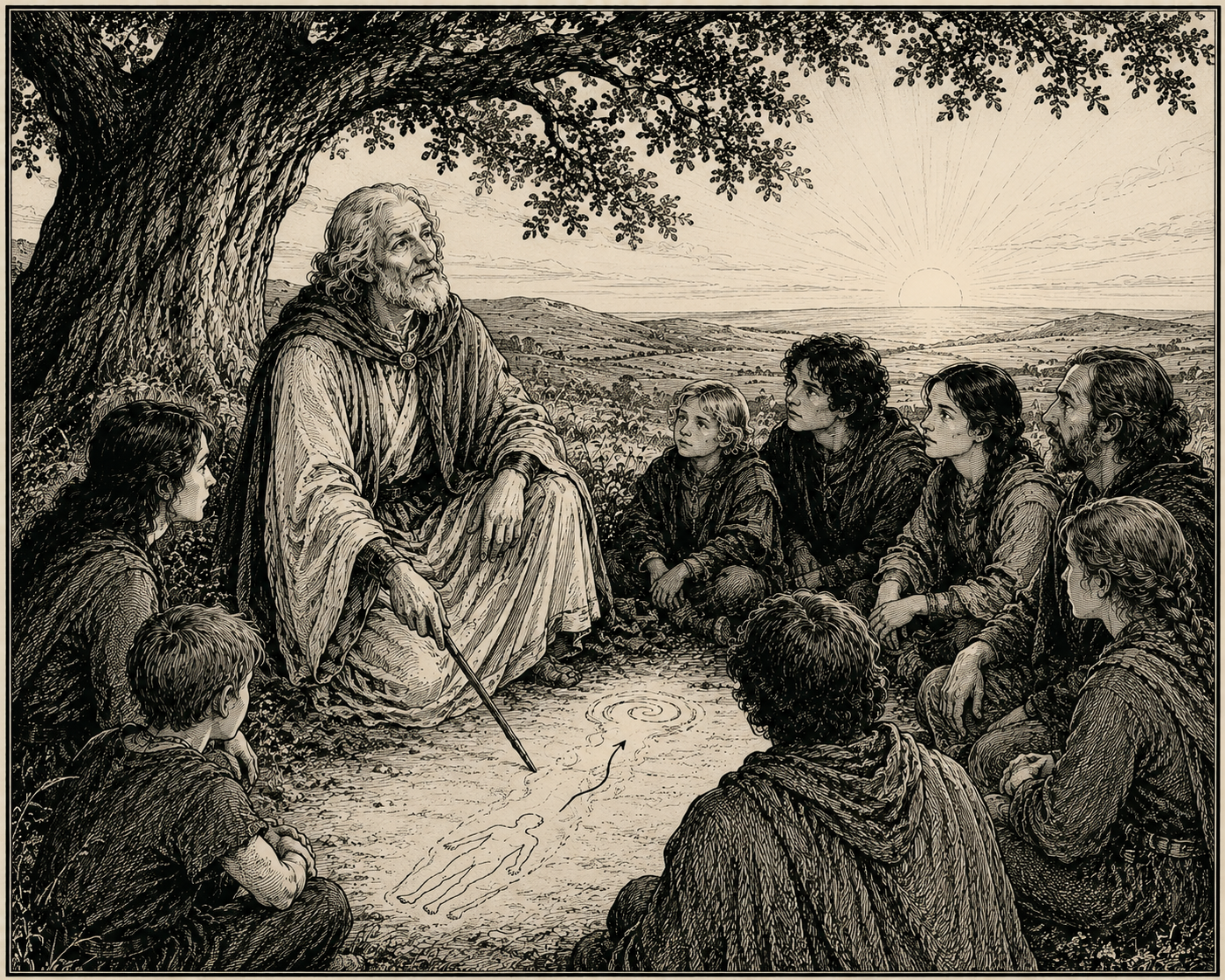
Caesar describes an archdruid presiding over a highly organised educational tradition in which students sometimes trained for 20 years.
For many centuries before the arrival of Christianity, these were among the few organised systems dedicated to higher learning.
Druids, Caesar noted, “...are engaged in things sacred, conduct the public and the private sacrifices, and interpret all matters of religion."
Religion, education and justice. They functioned as police and judiciary; elected their archdruid in synod-like assemblies. Community punishments included shunning, which is the equivalent of Church practice of excommunication.
Transition to Salvation
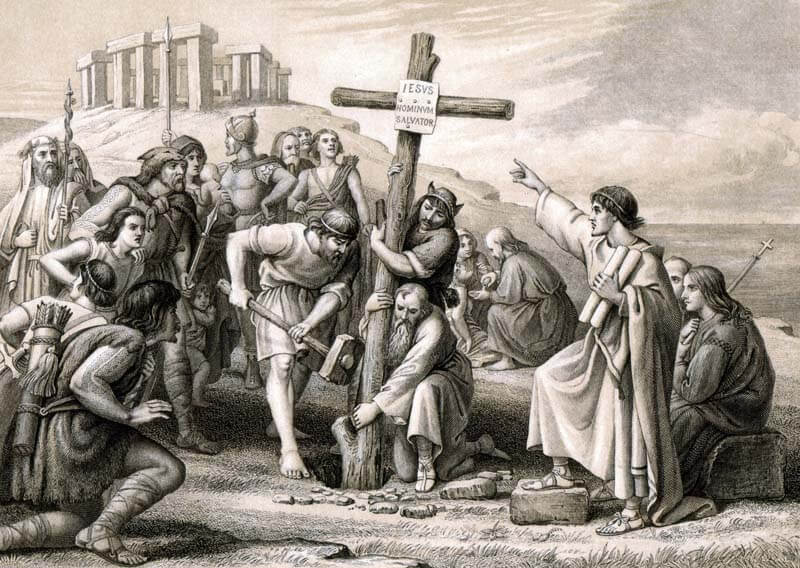
When Christianity arrived in Britain, it often adopted places already regarded as holy. Ancient wells became saints' wells; sacred groves became church sites. Hilltops and prehistoric monuments continued to attract religious attention.
Christian pilgrimage transformed rather than eliminated this tendency. People travelled to shrines to view relics, holy wells and tombs. The behaviour remained recognisably similar. People appear naturally drawn to the idea that some places are spiritually more elevated than others.
There is no evidence this happened with the Longstone, as it did for example at Avebury in Wiltshire and Glastonbury in Somerset; though not at Stonehenge. But one such Isle of Wight site may be Godshill, with its folklore of fairies and magic moving stones.
The continuity in the cases of Avebury and Glastonbury was not necessarily theological, but geographical and emotional. People continued returning to those same places because those sites felt meaningful. Perhaps Stonehenge and the Longstone had lost that connection.
Though even into modern times druids lead the solstice sunrise celebrations at Stonehenge, and a smaller contingent gather around the Longstone at solstice times.
Druids served as custodians of knowledge, dispensers of law, observers of ritual, medicine and mediation between the visible and invisible worlds.
The medieval priest fulfilled many of the same social functions.
Core beliefs changed, but the role of a learned intermediary between ordinary people and the sacred remained. A village that once sought guidance from a druid might, centuries later, seek guidance from a priest. The office changed but the need for guidance remained.
The Soul, the Afterlife & the Sacred Days
One of the strongest continuities is attitudes toward the dead. Classical writers describe Celtic societies as believing death was not an ending. Roman observers repeatedly remarked on Celtic confidence regarding survival after death.
Christianity also centred much of its emotional life around the continued existence of the soul.
A rich tradition of medieval saints and visions, purgatory narratives and miracle stories reveal a culture that continued to regard the dead as active participants in human affairs.
Another obvious continuity is the calendar. Celtic festivals of Samhain, Beltane, Imbolc, and Lughnasadh marked transitions in the agricultural year. Christianity introduced Christmas, Easter, All Saints, and numerous saints' days.
Both systems structured life around recurring sacred moments tied to seasons and harvests; to death's transition, to life's arrival; to darkness, and light.
The underlying rhythms of nature continued to shape religious experience.
Explore the History of Belief
The Longstone and Mottistone are only one point on a much longer journey. Across thousands of years, every civilisation has developed its own understanding of death, the soul and the possibility of another reality beyond ordinary experience.
The History of Belief series explores that continuing search. From prehistoric burial monuments and Druidic traditions to Christianity, Spiritualism, psychical research and the mythology of the ancient world, these articles examine how different generations have interpreted the unseen and why many of the same questions continue to reappear.
History cannot determine which beliefs are true. It can reveal how remarkably persistent they have been.
The Eternal Question
Britain has experienced many religious revolutions: Celtic, Roman, Norse, Christian, Protestant, Spiritualist, secular but certain human concerns remain stable.
Roman Britain told ghost stories of ancestor spirits; medieval monks told stories of souls from Purgatory; Victorian investigators glimpsed a ghost. Clairaudient investigator Margo Williams described a trapped personality seeking release.
The names change; the explanations are updated. The language has evolved but the phenomenon is recognisably related.
People still seek sacred places and consult spiritual authorities; people still honour the dead and tell ghost stories. People still make pilgrimages and divide the year into sacred seasons.
People still speculate on a reality beyond ordinary perception. In every country in the world people still ask if the dead remain near us. Still wonder why some places feel haunted; if the past continues to influence the present.
People continue asking: What happens when we die?
The names of the gods change; rituals change, but the questions endure.
History cannot tell us which understanding of the afterlife is true. It cannot prove the claims of druids, priests, mediums or paranormal investigators.
What it can reveal is something remarkable about ourselves. Across thousands of years, humanity has never stopped appointing interpreters to stand between the living and the mystery of death.
Every civilisation has asked them questions; every generation has searched for meaning beyond death.
The names of the gods have changed; the sacred books and ceremonies have changed. Yet for five thousand years, from the Longstone to the church at Mottistone, people have continued to look beyond the visible world and ask the same enduring question:
What lies on the other side of life?
Explore the History
 Nick Hammond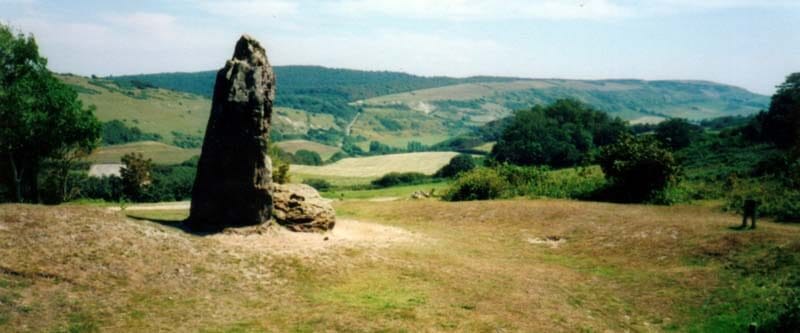
Related Essay
 Nick Hammond