How do intelligent societies come to regard violence as morally necessary? That it serves a higher purpose? Throughout history people have accepted terrible actions because they believed death was not the end.
The Old Stone Well
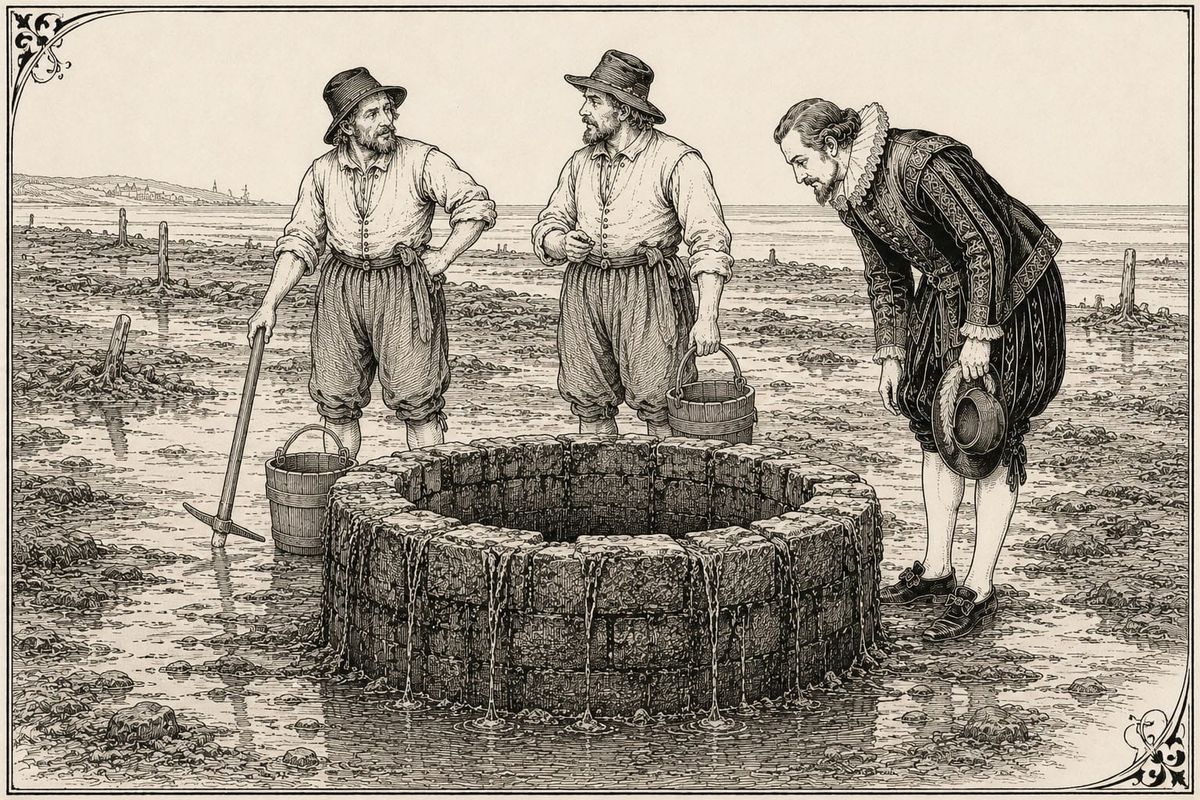
When an old stone well was discovered by unlucky Sir Bevis Thellwall under Brading Haven during the summer of 1609, people wondered how a well got to be underwater.
Victorian folklorist Abraham Elder in Tales & Legends of the Isle of Wight said it was a druid well. He expanded on that. Brading was the Isle of Wight druids' most sacred site, rivalled only by the Pillars of Ur, the series of sea rocks at the far end of the chalk spine traversing the Island, now known as the Needles rocks.
Mr Elder described, as if present, the evening scene of Brading's dim and very distant past: the annual druid party at the old well. A feast of druid delicacies, mistletoe and interesting pyrotechnics as the main event, in which a human being was to be ritually despatched into the afterlife.
In truth little is actually known of the hows and whys of druid religion but the reasons behind its acceptance of ritual sacrifice was noted.
The Wicker Man
There is ancient literary evidence that druids were associated with human sacrifice, but the strength and reliability of that information is a matter of debate.
Virtually all detailed descriptions come from Greek and Roman writers, not from the druids themselves. Druids left no surviving written accounts of their beliefs and practices.
Four independent Roman and Greek writers describe ritual life-ending among Celtic peoples. They disagree over details but broadly reinforce one another.
Roman general, Julius Caesar states that the Gauls believed human life could only be redeemed by the sacrifice of another human life. He described criminals being burned alive inside enormous wicker structures, the famous "Wicker Man" account:
"They have figures of immense size, whose limbs formed of wickerwork they fill with living men."
Caesar specifically connects these practices with the religious system overseen by druids. However, historians are cautious because Caesar was a conqueror writing about peoples he was actively subduing. Portraying the Gauls as barbaric helped justify Roman conquest.
Geographer Strabo reported victims being stabbed and their deaths interpreted as omens. He specifically mentions druids and related priestly classes participating in such rituals.
Diodorus Siculus similarly recorded that certain Celtic priests observed the death agonies of sacrificial victims to predict the future.
This account broadly agrees with Strabo's, suggesting they may have drawn upon earlier common sources.
Roman historian Tacitus described the Roman assault on the druid stronghold of Mona (Anglesey) in CE 60. He writes that the Romans found altars "stained with the blood of captives" and regarded druidic rites as involving human sacrifice.
Again, this is a Roman source describing Rome's enemies.
Archaeological Evidence
These literary accounts would be weaker if archaeology found no support for them. However, some discoveries suggest ritual end-of-lifing did occur in Iron Age Celtic societies.
One possible ritual sacrifice is Lindow Man, found in Cheshire, England, who died around the 1st century CE. He appears to have suffered multiple forms of death: a blow to the head, strangulation, and throat-cutting.
Across northern Europe dozens of bog bodies have been found. Many show evidence of violent deaths that appear ceremonial rather than criminal. Some scholars see them as sacrificial offerings to deities.
The difficulty is that these remains rarely allow us to identify whether druids were involved.
Answers and Questions
Most historians today occupy a middle ground: Human sacrifice probably did occur in some Celtic societies. The Roman writers likely exaggerated its frequency and scale.
There is no firm evidence that every druid community practised it. The famous "Wicker Man" may be real, exaggerated, or entirely literary symbolism. Archaeology supports the existence of ritual killing but does not prove all Roman descriptions.
A comparison is that if future historians only possessed propaganda written by Rome's enemies, they might conclude that Romans spent all their time feeding Christians to lions.
The event happened, but the emphasis could distort the reality.
One of the strongest pieces of indirect evidence is what happened after Rome conquered Celtic territories. Several Roman emperors specifically outlawed druidism.
Writers such as Pliny the Elder mention imperial suppression of druidic rites. The Roman authorities repeatedly claimed that human sacrifice was among the practices being prohibited.
That does not prove the accusations were true, but it suggests that the charge was not merely invented once by Caesar and forgotten. Multiple Roman authors over more than a century repeated it.
Most modern scholars say the evidence suggests that ritual human sacrifice probably occurred in some druidic contexts, but the dramatic Roman descriptions should not be accepted uncritically.
Today we shudder at such barbaric practices, asking why intelligent people believed such practices were necessary.
It is a question that remains unanswered.
Related Essay
 Nick Hammond
End-of-Life Events in Medieval Europe
A comparison can be made between alleged druidic human sacrifices and the religious violence of medieval and early modern Europe.
Both involved societies employing violence they believed was religiously justified. In each case spiritual authority, social order and fears for the welfare of the community shaped behaviour.
There were, however, important differences. If the Roman accounts are broadly reliable, druidic sacrifice was understood as an offering intended to maintain harmony between the human and divine worlds.
The victim's death was believed to possess religious purpose.
By contrast the Holy Inquisition and later witch trials were judicial processes, however flawed intended to identify and punish those believed to threaten Christian society.
Medieval authorities often believed that heresy, witchcraft or demonic influence endangered both the individuals involved and their wider communities.
Punishment, however brutal it appears today, was presented as preserving social order and the eternal welfare of souls.
Do As I Say, Not As I Do
The irony is that societies frequently condemned the violence of others while accepting their own. Roman writers portrayed druids as barbaric, yet Rome practised crucifixions, public executions and gladiatorial combat.
Medieval Christian Europe condemned pagan cruelty while employing torture, judicial burning and religious persecution.
Scale also matters. Even if the most dramatic Roman descriptions of druidic sacrifices are accepted, the numbers involved were probably relatively small.
By comparison the European witch hunts between roughly 1450 and 1750 resulted in perhaps 40,000 to 60,000 executions, while Europe's religious wars claimed vastly more lives.
Iron Age tribal societies simply lacked the populations and political structures capable of violence on such a scale.
Modern historians therefore avoid portraying one age as uniquely barbaric, and instead ask why intelligent societies repeatedly become convinced that violence is morally necessary?
The answer seems to lie less in the religions themselves than in the universal human tendency to believe that a higher truth justifies extraordinary actions.
Ideological differences
The greatest difference between modern readers and many ancient societies may not be their attitude toward violence, but their understanding of death.
Modern secular societies generally regard death as the irreversible end of individual consciousness. If that assumption is correct, taking a human life destroys something unique for ever.
Violence therefore becomes one of the gravest acts imaginable.
The ancient world often began from a very different premise. Several classical writers state that one of the principal teachings of the druids was that the soul survived bodily death.
Julius Caesar claimed they believed the soul passed from body to another, though historians still debate whether he meant literal reincarnation or simply the persistence of consciousness.
Whatever the precise doctrine, death was apparently not regarded as annihilation.
If Caesar understood the druids correctly, then a sacrifice, however horrifying it appears today, would have been interpreted within an entirely different moral framework. The victim's existence had not ended but merely changed its state.
Death marked a transition rather than extinction.
Christianity and the Afterlife
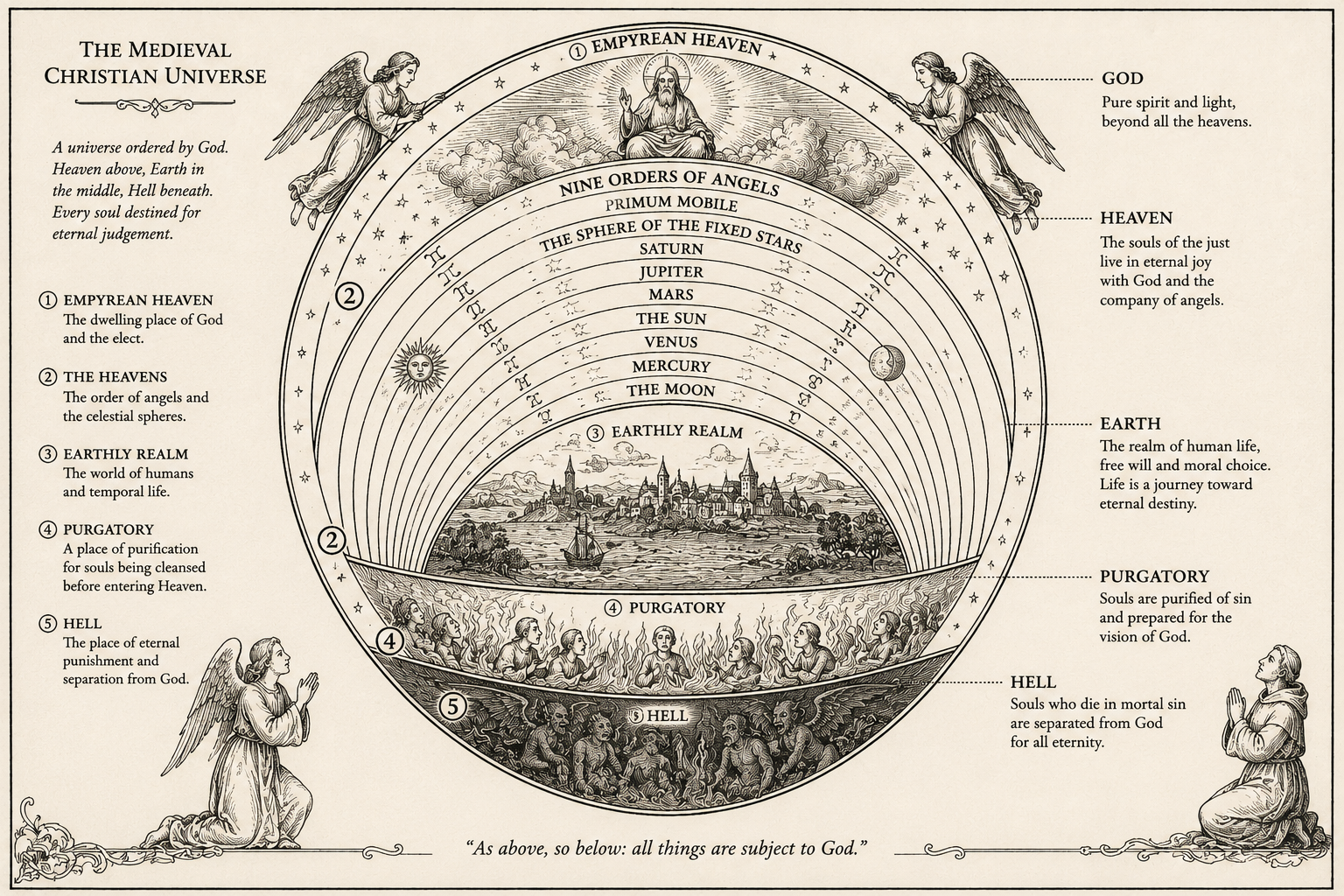
Christianity also rejected the idea that death was the end, yet its understanding of what followed differed deeply.
Instead of repeated earthly existence, Christianity taught resurrection, divine judgement, Heaven and Hell.
Every soul possessed eternal significance, but its destiny depended upon its relationship with God rather than the cycles of nature.
That distinction shaped very different religious outlooks.
Druidic belief appears to be closely connected to the environment and its landscape. Ancestry and tribal continuity seemed important. Sacred groves, rivers and hills formed part of an ongoing relationship between humanity and the natural world.
Medieval Christianity increasingly centred authority upon a universal Church whose concern extended beyond tribe or landscape to the salvation of all humanity.
The Afterlife and Now
Despite those differences, both traditions shared an assumption that modern secular thought often rejects: human consciousness survives death.
The same assumption reappears centuries later in 19th century spiritualism. Instead of reincarnation or divine judgement, spiritualists proposed continued personal development in an unseen world.
Modern paranormal investigators approach the question differently again, searching for evidence that personality, memory or consciousness may occasionally interact with the living.
These traditions disagree about what lies beyond death, yet they begin from the same extraordinary premise. Death changes the condition of a person, it does not necessarily extinguish them.
Perhaps that explains why beliefs about the afterlife have proved so remarkably persistent throughout history. If people genuinely believe existence continues beyond the grave, then death acquires a very different meaning.
That does not justify the actions some societies have taken in its name, but it helps explain why intelligent people, acting from sincere conviction, could reach conclusions that later generations struggle to comprehend.
Silence, Speculation & the Big Question
Almost everything we know of druidism comes through Roman observers, Christian chroniclers, folklore, archaeology, and later romantic reconstruction as presented by Abraham Elder.
We have nothing of their own voice.
There is always a temptation to fill the gaps with admiration or condemnation. The finale of Elder's tale is an end-of-life event that triggers a catastrophic flood to gush up from the well and submerge an area of 700 acres, that came to be known as Brading Haven.
We have absolutely no idea if that happened, but probably not.
Whether we read Caesar's account of the druids, medieval accounts of saints and souls, Victorian spiritualist reports, or the case files of Margo Williams, we repeatedly encounter the same underlying assumption:
Death changes the state of a person, but does not necessarily extinguish them.
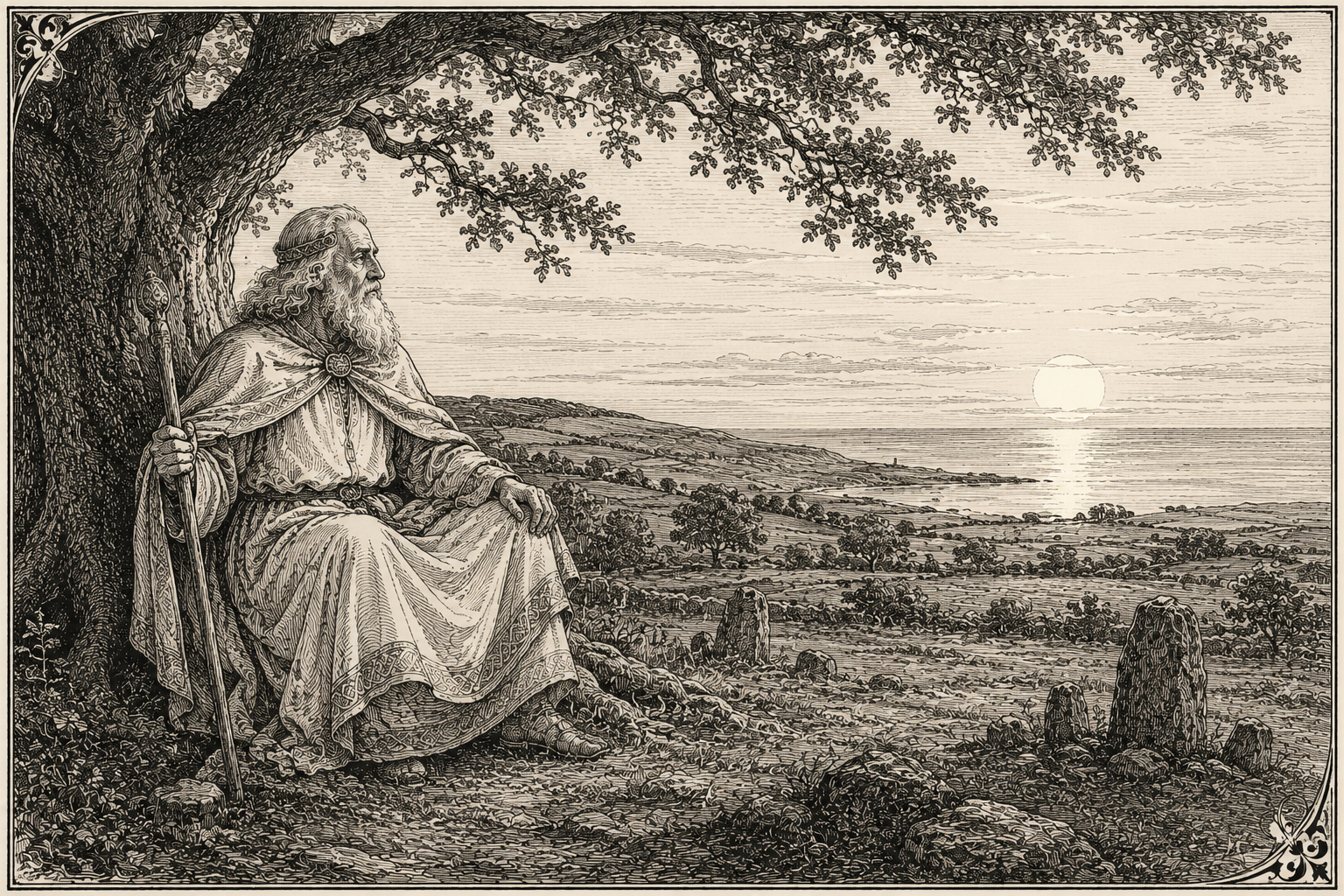
The druid beneath the oak, cutting mistletoe under the Moon, is acting within a worldview in which the soul continues beyond death and the natural world is sacred.
The Tudor priest on Tower Hill acts within a Christian worldview in which salvation, damnation, and obedience to divine authority are paramount.
The witch-finder arrives convinced he is protecting society from hidden evil.
The inquisitors sit convinced they are defending religious truth and social order.
In every case, the participants generally believed they were serving a higher good. That does not mean the outcomes were necessarily good, but it does explain why such systems persisted for centuries.
Why Intelligent People Were Capable of Cruelty.
That is the real mystery. Civilisations differ enormously in their gods, rituals and sacred books, yet they repeatedly arrive at the same conviction: death is not the end, and eternal realities justify present actions.
Whether they were druids beneath an oak, inquisitors in a cathedral or modern spiritualists searching for evidence of survival, each believed they were acting in the light of a truth greater than themselves.
History leaves us asking whether they were right.
And why humanity has never stopped searching for the other side of death.
Tag Hub: History of Belief