Did war, conquest and religious change erase one of the Isle of Wight's oldest churches?
The Missing Virgin
The stone Virgin Mary who once stood above Brading church doorway disappeared centuries ago. Yet she may not be the greatest thing lost from Brading.
The greater mystery is the church itself. One of the Island's oldest communities ought to have possessed a church when William the Conqueror's surveyors compiled the Domesday Book in 1086. Yet no church is recorded. Why?
The Isle of Wight's Oldest Town
Notable local noble Sir John Oglander noted during the 1600s how his home town Brading probably was the Isle of Wight's first major settlement. In his reflective notebook, he quilled how Brading was '...ye only towne for receypt of strangors that came by shippinge.' Friends and enemies, both.
Today it certainly is a top must-visit town on the mystery, history and haunting tour of the Isle of Wight.
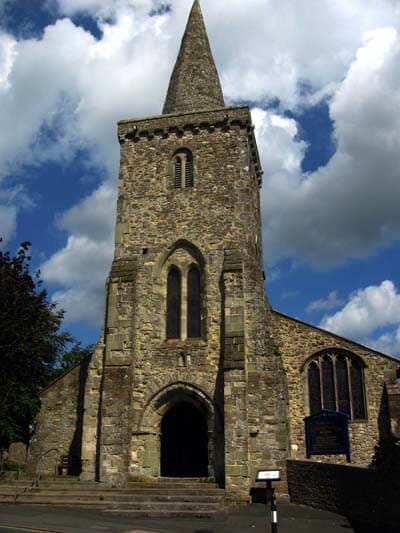
Curiously, the truly momentous history of Brading is not immediately apparent to visitors, nor the clever medieval engineering work carried out upon the church spire during the CE 1200s whereby an outward curve was deliberately created to offset a look of concavity.
Across the road stands the Old Rectory, one of the Island's most famous haunted houses. Yet even this building is overshadowed by a deeper mystery: the history that appears to have vanished from Brading.
 Nick Hammond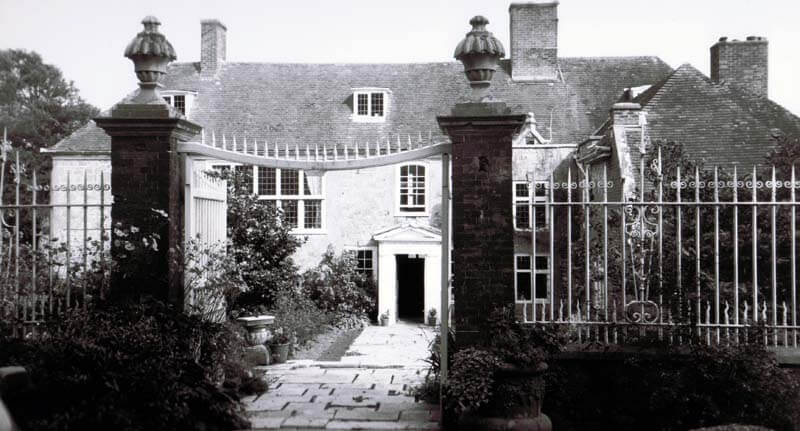
The Dragon's Back
The name 'Brading' according to Wight historian Mills is among the most ancient on the Isle of Wight and means: (The settlement of) dwellers on the hillside', though no one knows how far back into pre-history the settlement was founded.
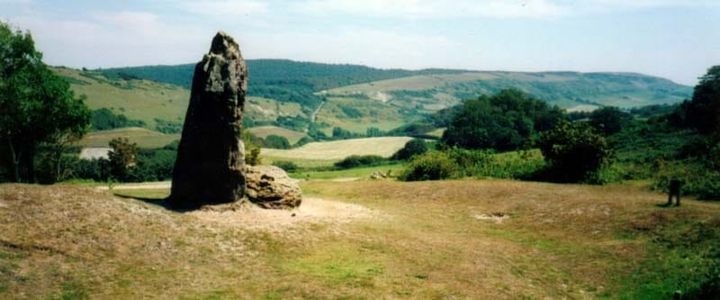
This is the eastern end of the dramatic-named Dragon's Back, a chalk-spine which runs across the Island. Here when Britain and continental Europe were joined, when Ice Age glaciers advanced and retreated and ridges were quite literally the high-ways above the wolves and marshes.
Most of that route has long since fallen into the sea, except the Island section from once-connected Sussex, Culver Cliff to the Needles Rocks (which originally carried on into Dorset, joining Portland).
Archaeological finds in nearby Priory Bay date from the Paleolithic period and flint-working sites were found in this area.
Roman Brading and the Two Virgins
In AD 43, Titus Flavius Vespasian, future Emperor of Rome at the head of the Second Legion arrived in Brading quay.
Some say the magnificent Roman villa uncovered in nearby Morton was his, but others doubt this since he died in AD 79 and the villa is dated to the AD 200s.
However this villa may have belonged to a bigger celebrity than Vespasian. An emperor who recognised both of Brading's holy Virgins.
Many Roman settlements contained shrines dedicated to household and civic deities. Among the most important was Vesta, goddess of the sacred hearth fire.
No evidence has yet been found for a temple of Vesta in Brading. Yet elsewhere in Britain Christian churches were sometimes established close to earlier sacred sites. Whether St Mary's occupies such a location remains unknown.
Vesta and the Virgins
Festivities for Virgin Vesta are noted, witness accounts record this holiday as immensely popular. Across the Roman world Vesta was honoured through public festivals and processions. Whether such ceremonies occurred in Roman Vectis is unknown but possible.
Emperor Constantine accepted the arrival of a new virgin from the Middle East, promoted by devotees of Christianity; and for a while Rome recognised two holy virgins, until an obvious competition problem arose in the streets every year.
To solve this, in CE 380 Byzantine emperor of Rome Theodosius the Great abolished all worship of Vesta throughout his new exclusively-Christian empire. He also ordered an end to the Olympic Games.
Both ancient flames were extinguished.
The Saxon Island of Wihtgar
A hundred years or so later, Rome fell. The so-called Dark Ages followed. By the early fifth century Roman administration had disappeared from Britain. Communities such as Brading entered a poorly documented period that historians once called the Dark Ages.
No one knows how the inhabitants of the Isle of Wight organised their communities, what their politics were, whom they worshipped. We can only assume Virgin Mary remained the object of veneration, not Virgin Vesta.
No information is available until CE 530 when the Anglo Saxon Chronicles note arrival on the Island of Saxon warlords Cerdic and son Cynric who defeated the Island's defenders at Carisbrooke, seized control of the Island.
Following the death of Cerdic in 534, Cynric assumed control and granted the Island to his nephews, (or cousins) Stuf and Wihtgar.
No one knows what the pagans Cyrdic and Cynric, Stuf and Wihtgar did with Brading's Virgin Mary statues. Maybe she was kindly treated, given membership among their own goddesses and gods for a while.
The rest of Britain was absorbed by incoming waves of Saxon settlers, all of whose kings and warlords, during the next hundred years, converted to Christianity following Saint Augustine's Gregorian mission to Britain in CE 597.
However, the Isle of Wight remained pagan. Something of an indulgence afforded by the king of the South Saxons, Aethelwahl, the first Christian king of Sussex.
Britain's Last Pagan Island
Aethelwahl welcomed the arrival of the Christian missionary and saint-to-be, Wilfrid. Banished from his Northumberland homeland soon Wilfrid regarded the Isle of Wight's remaining pagan population as a spiritual challenge and continued to advocate its conversion.
Aethelwahl did not give assent for Wilfrid to undertake the conversion of the Isle of Wight to Christianity. No one knows why he kept the island as an offshore "pagan park".
Wilfrid befriended and agreed to be the "spiritual father" of an ill-tempered warrior outlaw named Caedwalla who lived in the Sussex forests. A sequence of grave consequence soon followed.
Caedwalla assassinated Aethelwahl sometime around 685 and assumed control of his kingdom, then with his brother Mull the Mauler they waged war on all the communities across southern England, until Caedwalla was king of the southern Saxon world.
According to Venerable Bede, the Saxon chronicler of early church history, Wilfrid was present when the Isle of Wight was conquered by king Cædwalla in 697.
Their campaign was so severe that Bede wrote of Cædwalla's intention to replace much of the population with settlers from his own kingdom.
Bede's account suggests a catastrophe for the Island's population, though the scale of the losses remains debated.
 Nick Hammond
Looking for Clues
Although archaeological finds in the area hint at a possible invasion-force landing site, it is entirely conjecture that Brading was the place where in AD 704 Wilfrid and Caedwalla stepped ashore to baptise the last of Britain's unbelievers.
Maybe the mystery of the missing church is a clue, but important questions remain.
Is Sir John Oglander correct in his assertion that Brading was the island's oldest town? The Priory Bay flintworks prove communities existed here since Neolithic times, but was Brading an active community even through the Island's Celtic period?
The presence of Roman remains in the area proves occupation, but was the community of sufficient size for temples to be built here? Evidence of these is less easy to uncover, than for example the nearby villa.
In many historic communities, old pagan shrines and sanctuaries were repurposed; their precious materials of building stone washed and blessed with holy water.
The conversion of a temple of the Virgin Vesta to the church of the Virgin Mary could easily be accomplished in a day.
Was there a temple of Vesta that became a church of Saint Mary in Brading? Did it temporarily revert to paganism during the early Saxon occupation?
The Mystery of the Missing Church
The mystery is, why does Brading not include a church in the Domesday Book, the property inventory survey ordered by William the Conqueror during the 11th century.
By 1086 Domesday recorded churches across England with remarkable thoroughness. Yet researchers have long noted the absence of any clear reference to St Mary's at Brading.
Other towns and villages are listed: Freshwater, Arreton, Carisbrooke, Calbourne, Shalfleet, Bonchurch; others un-named are believed to be Godshill, Newchurch, Niton and Whippingham.
Brading is not mentioned. Why, if it is the oldest town on the island. Was Sir John wrong in his estimation?
"Oversight," say some local historians of the survey's list. Its absence is an administrative error or documentary confusion.
"No chance," reply the mystery-mongers. "Domesday's meanness missed nothing." Brading should have had a church.
Was a much older church lost before the Norman period and later rebuilt?
If Brading was already an important settlement and harbour, what happened here during the conquest?
Could Brading have suffered catastrophic destruction during this conflict? If so, might that explain why later records appear strangely silent about what should have been one of the Island's most important churches?
Maybe the town suffered such devastation in the attack it took centuries to be rebuilt. Like the Homeric city of Troy for example, any earlier foundations may still lie hidden beneath later centuries of rebuilding.
What Became of the Virgin?
Local detectorists believe the statue of the Virgin Mary that stood above the church doorway most likely was cast away and lost when king Henry VIII ordered all graven images removed as idolatrous, back in 1539.
And introduced his new laws and punishments for the poor and needy in the community since he closed Quarr Abbey. The public stocks remain to this day in the arched building outside the church door.
Perhaps the lost statue of the Virgin Mary still lies beneath the old haven fields, waiting for a detectorist's coil to pass overhead.
Yet the greater mystery remains unsolved.
Somewhere beneath modern Brading may lie traces of an earlier church, perhaps even an earlier town, caught in the violent centuries between Rome, Saxon conquest and Norman England.
If Cædwalla's assault truly devastated this community, the missing church may be more than a clerical omission in Domesday Book. It may be the last surviving clue to a chapter of Island history that has almost entirely vanished.
Like Troy before its rediscovery, the evidence may still be there.
Waiting.