Strange things happen in the old chapel at Swainston Manor. Some visitors hear music. Others glimpse guests who seem to belong to another century. Are they ghosts, or tears in time?
Do the sounds and figures reported at Swainston Manor belong to ghosts, or to another moment in time?
Around Halloween island folk re-set clocks backward by an hour. Generally clocks tick forward. Or so we all assume. Some passing scientists in the marvellous Blacksmith's Pub on the Calbourne Road say "Time is an illusion," on hearing the landlord call "Last Orders, please!" one hour sooner than the day before.
That's a big thing to say. Is time an illusion? Mostly we think of time as moving forward in linear fashion. Even though yesterday's 6pm is today's 5 o' clock, and that missing hour is unrecoverable, it is gone. There is only the "now" progressing into the future.
History does not exist outside of history books, is what most of us believe.
During the 1990s when Swainston Manor operated as a hotel, visitors occasionally reported experiences that were difficult to explain. Some heard music. Others became aware of unexpected guests.
Time may be more nuanced than we realise. A discussion on current theories of time and how these might explain ghostly phenomena can be found in this archive.
Can the idea of a tear in time explain the weird things that happen at Swainston Manor?
 Nick Hammond
The Summer Palace
Among the Isle of Wight’s many beautiful scenes this particular combination of scenery and substance so delighted the powerful Saxon bishops of Winchester, during the first millennium CE they chose Swainston as their summer palace.
Despite Viking interruption from time to time - Danish warlord Sweyn Forkbeard, father of King Canute probably gave his name - it belonged to the Church until King Edward I, Longshanks, came to the Isle of Wight and took it from them.
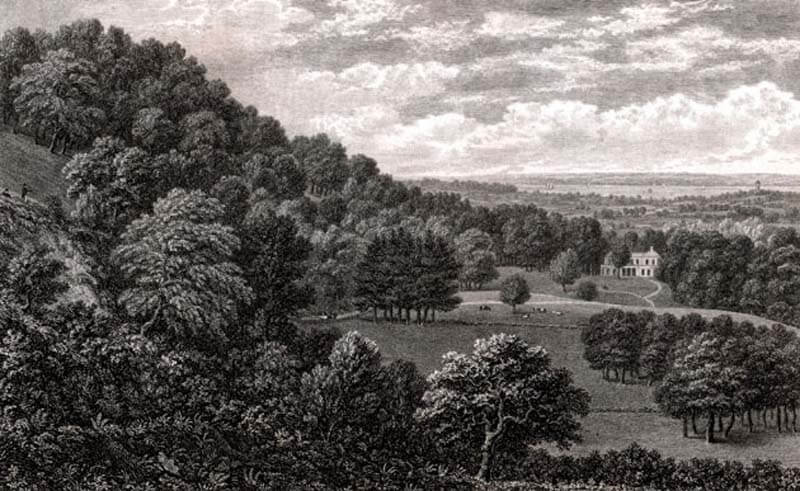
Longshanks on the Isle of Wight
The king arrived at Swainston during November 5th 1285, two years after his invasion of Wales and one year after the birth of son Edward II.
Historian Albin describes this royal visit in his 'New, Correct and Much Improved History of the Isle of Wight,'
'...The King deprived John di Pontiserra of this manor, harassed him frequently by divers acts of displeasure openly manifested and declared. At length the Bishop, to purchase the King's peace, did agree not only to surrender the manor into his hands but pay a fine of £2000.'
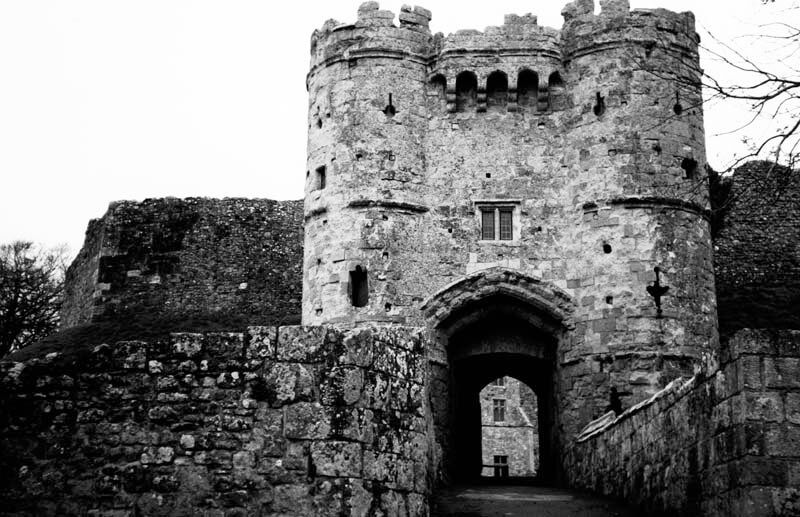
Among the island's mysteries is why Edward did not stay at Carisbrooke Castle, home of Lady Isabella the richest single woman in the kingdom.
Local historians suspect she wouldn't appreciate all the minstrels and harpists; or foot the bill. The royal household consumed astonishing quantities of food and drink. Contemporary accounts record beef, venison, pigs, game birds, wine, beer and even delicacies such as porpoise and whale.
Edward spared Lady Isabella that problem.
Seven centuries later, echoes of that medieval world may still linger around the old chapel.
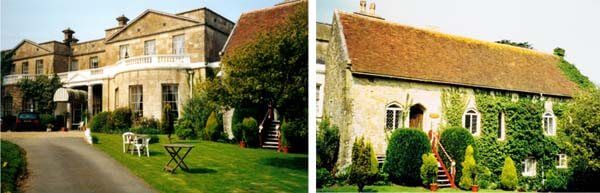
The Royal Party Parties On
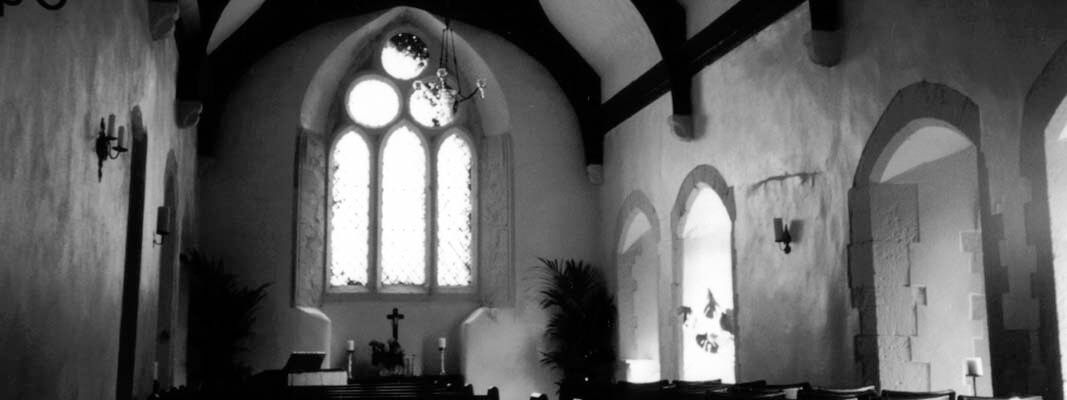
Miraculously some of the original medieval buildings remain. The old chapel is well preserved, and when Swainston Manor opened its doors as a hotel during the 1990s, the chapel provided a venue for wedding ceremonies.
From time to time sensitive brides and grooms believed there were more people in the chapel than invited to their event. Some attendees reported hearing old-fashioned minstrel-music wafting in through the chapel door, and assumed the DJ played a joke.
On rare occasion outside the chapel, a youngish woman in blue velvet robe and upturned hat sits in the garden. Late arrivals see her and think they missed the invitation about the wedding being medieval fancy-dress.
Paranormalists wonder if it is the ghost of Lady Isabella. But those who have seen her claim she looks too real to be a ghost. Sometimes the Blacksmith's bar-person offers another possibility based upon overheard conversations by passing scientists: "The old chapel is a wormhole into the past."
And, presumably for King Edward Longshanks, into the future. Wormholes work both ways.
Most people call such experiences ghosts. A few passing scientists in the Blacksmith's pub suggest another possibility.
Time sometimes leaks.
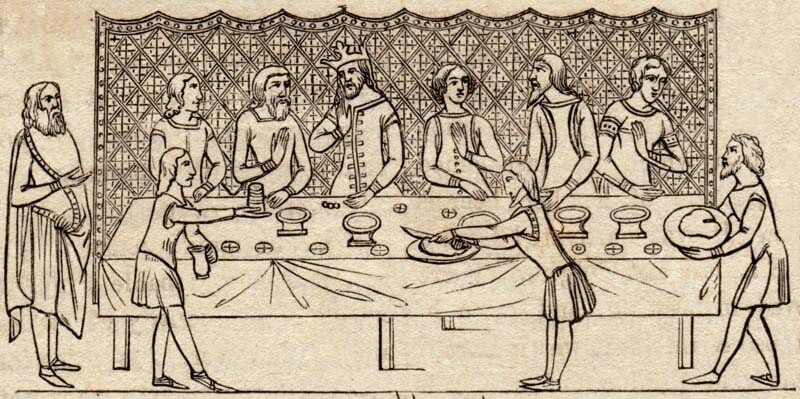
A Wormhole in the Chapel?
Modern physics has produced some surprising ideas. Although we experience time as a steady flow from past to future, some theories describe time more as a landscape in which past, present and future all coexist.
Some physicists have proposed the existence of hypothetical tunnels through space-time known as wormholes. These remain entirely theoretical, but mathematics suggests such structures may be possible.
If time is a landscape rather than a river, then an intriguing question follows. Could certain places somehow connect different moments in that landscape?
No scientist has suggested that Swainston Manor contains a wormhole. Yet the reports from the old chapel are curious. Visitors hear music that seems to belong to another century. Others glimpse people dressed in medieval clothing who appear completely solid and real.
Perhaps they are ghosts. Or perhaps, for a moment, two different times briefly touched.
It is only a speculation. But then so is much of modern theoretical physics.
Atmospheric Photograph?
Paranormalists who prefer less theoretical physics, wonder if the Stone Tape, or Atmospheric Photograph theory of ghosts applies to Swainston's supernatural occurrences.
That old historic buildings absorb human experience caused by activity, or that ghosts are "atmospheric photographs", moments of great emotional stress imprinted by a trauma-sufferer into the atmosphere or architecture of a location.
Some suspect the intensity of emotional trauma is more acute at higher social levels; especially in royal political society where ambition and betrayal carry greater consequence for personal survival.
And so the weird stuff that happens at Swainston Manor may simply be a ghostly memory caused by bishop Pontiserra's shock at the cost of Longshanks' party requests. It is one answer.
It is a 4 mile horse ride along the Calbourne road between Carisbrooke Castle and Swainston Manor. Two of Britain's most powerful rulers were in close orbit.
If the mysterious woman in blue belongs to Swainston's past, one obvious candidate is Isabella de Fortibus, the most powerful woman on the Island during Edward's lifetime.
 Nick Hammond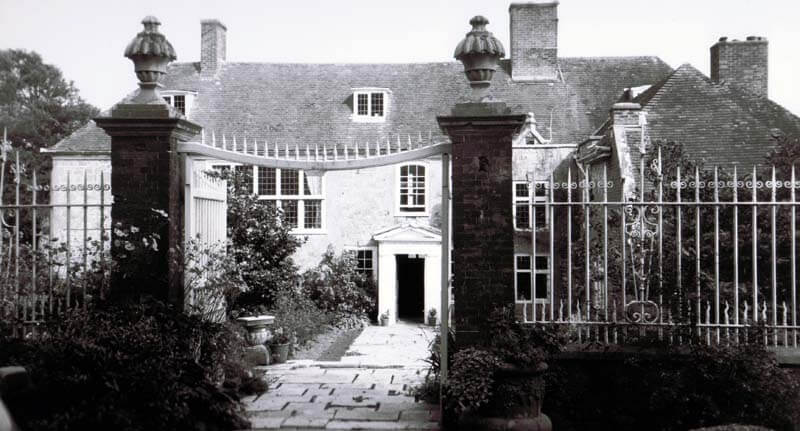
The King Versus the Queen of Wight.
Edward Longshanks and Isabella de Fortibus each ruled their domains.
Born 17th June 1239, adult Edward I stood head and shoulders above most people. "Dressed plain and unostentatious; little different from the ordinary citizen," said those who met him. 'When asked why he would not wear more sumptuous clothes, Edward replied that it is impossible to add or diminish real worth by outward apparel.
According to biographers,
"...His light yellow hair of childhood turned to black with adulthood. In speech he was hesitating, but eloquent. His mind resolute, ambitious, firm and courageous yet tempered with that rare discretion which never pursued objectives beyond his power of attainment, and never underestimated what was needed to achieve important designs."
Source: W.H.S. Aubrey 'History of England'
Isabella de Fortibus
Who knows how many women in king Edward's kingdom were tough as Longshanks. But one of them lived on the Isle of Wight.
Isabella de Fortibus, last of the de Redvers family; described as the 'equal of any man in a man's world.' Formidable, intelligent and energetic; patroness of religious houses. Unafraid of any clergyman she summoned the bishop often to her court.
Isabella owned the Isle of Wight.
Isabella de Fortibus Brief Profile
Married aged 12 to William de Fortibus, all five of her children died before adulthood, and she was widowed aged 23.
Daughter Aveline married King Edward's younger brother Edmund 'Crouchback', at the age of eleven and died four years later.
When Isabella's brother Baldwin died two years after her husband, poisoned at his brother-in-law's party, Isabella inherited the family's huge fortune, to become the richest single woman in the kingdom.
And the last female ruler of the Isle of Wight.
Some local historians say Edward wanted to remove her family's feudal privileges and return the Island to crown possession. Favourites of his great, great, great grandfather Henry I, the de Redvers had complete authority over the Isle of Wight.
But maybe there was a deal in place. Isabella signed the paperwork on her deathbed bequeathing her island to the king.
Paranormalists with a mind for melodrama reason the blue-velvet-clad ghost in the garden cannot be Isabella, because she wasn't invited to the party.
That garden ghost outside the chapel looks too young to be Isabella, say those who've got up close enough to see. But assume she is connected to the minstrel music sometimes heard by brides and grooms playing in the old chapel.
Or the uninvited ghostly guests present among the well-wishers, watching future weddings through a wormhole.
 Nick Hammond