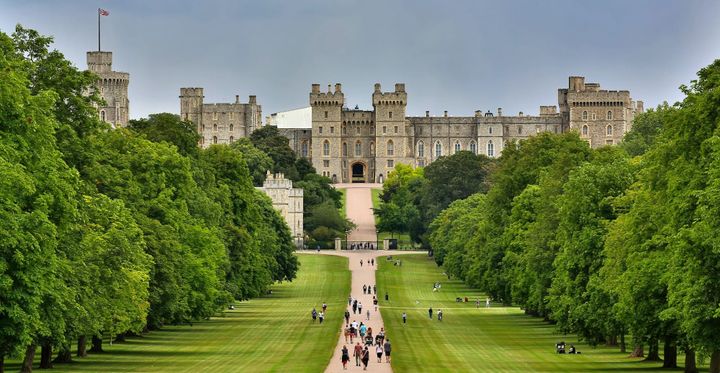
Most ghosts aren't friendly and engaging like cartoon phantom Casper, they just do their thing, indifferent to our presence. That's what makes them so unsettling. Maybe there is a good reason for this.
Persistence of Human Presence at Henry VIII's Palace
There is something deeply unnerving about some ghosts. Nothing monstrous or threatening. It is because they seem entirely unaware of us.
A woman runs screaming down a corridor. A figure walks silently through a doorway and disappears. Footsteps repeat along familiar routes.
Witnesses watch scenes unfolding with strange indifference to the living observer standing only feet away.
The apparition does not communicate. It simply continues as though another moment is still happening somewhere nearby; which raises a disturbing possibility.
What if some ghosts are not “spirits” in the religious sense at all?
What if they are people trapped in time?
Hampton Court's Haunted Gallery
Few locations embody this question more powerfully than Hampton Court Palace. Built first for Cardinal Thomas Wolsey before becoming one of the great palaces of King Henry VIII, Hampton Court is saturated with emotional intensity.
Its rooms and galleries were the scenes of intense human drama, smouldering with royal ambition and political intrigue. Betrayal happened often; childbirth not often enough. Terror and grief soured its atmosphere.
Unlike a ruined castle emptied by history, Hampton Court still feels inhabited. Its long galleries and chambers preserve atmosphere in the architecture and furnishings.
Atmosphere matters.
For centuries Hampton Court palace has generated reports of apparitions and weird experiences. Famous claims of sightings of an apparition of Queen Anne Boleyn wafting through palace galleries.
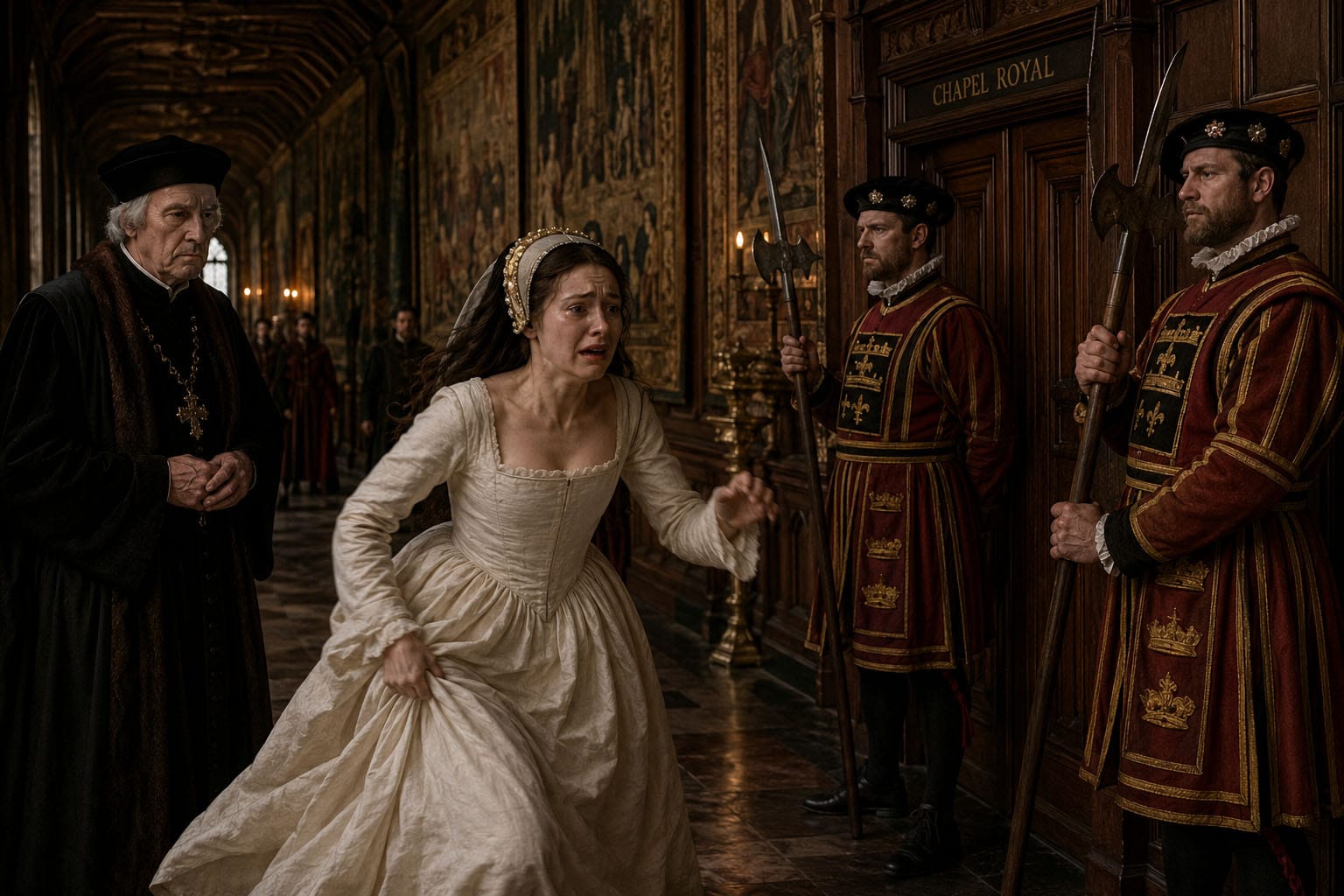
Or Catherine Howard, Henry VIII’s fifth wife, who ran screaming through what became known as the Haunted Gallery. Moments after learning she faced arrest and execution for adultery.
Witnesses across generations have heard sounds of distress in the gallery. Glimpsed a figure rushing toward the doors to the Chapel Royal, half-way down its length.
Security staff describe sudden drops in temperature, a change in vibe; an overwhelming sense of another presence moving through the palace.
We today automatically call such phenomena "hauntings". But does the word obscure more than it explains?
The King's New Favourite
The behaviour described in many ghost encounters does not resemble communication from the dead. It looks like repetition, a replay.
Actions recur with mechanical consistency, tied to location. The figure appears trapped within a pattern.
This idea aligns with modern interpretations of time.
Human beings naturally experience time as movement. The present feels immediate, the past instantly lost, the future approaches.
Twentieth-century physics transformed that simple picture. Einstein's theory of relativity merged space and time into a single structure called spacetime.
In several interpretations of modern physics, all moments may continue to exist simultaneously within this structure. The past is not lost into nothing. It remains embedded within reality itself.
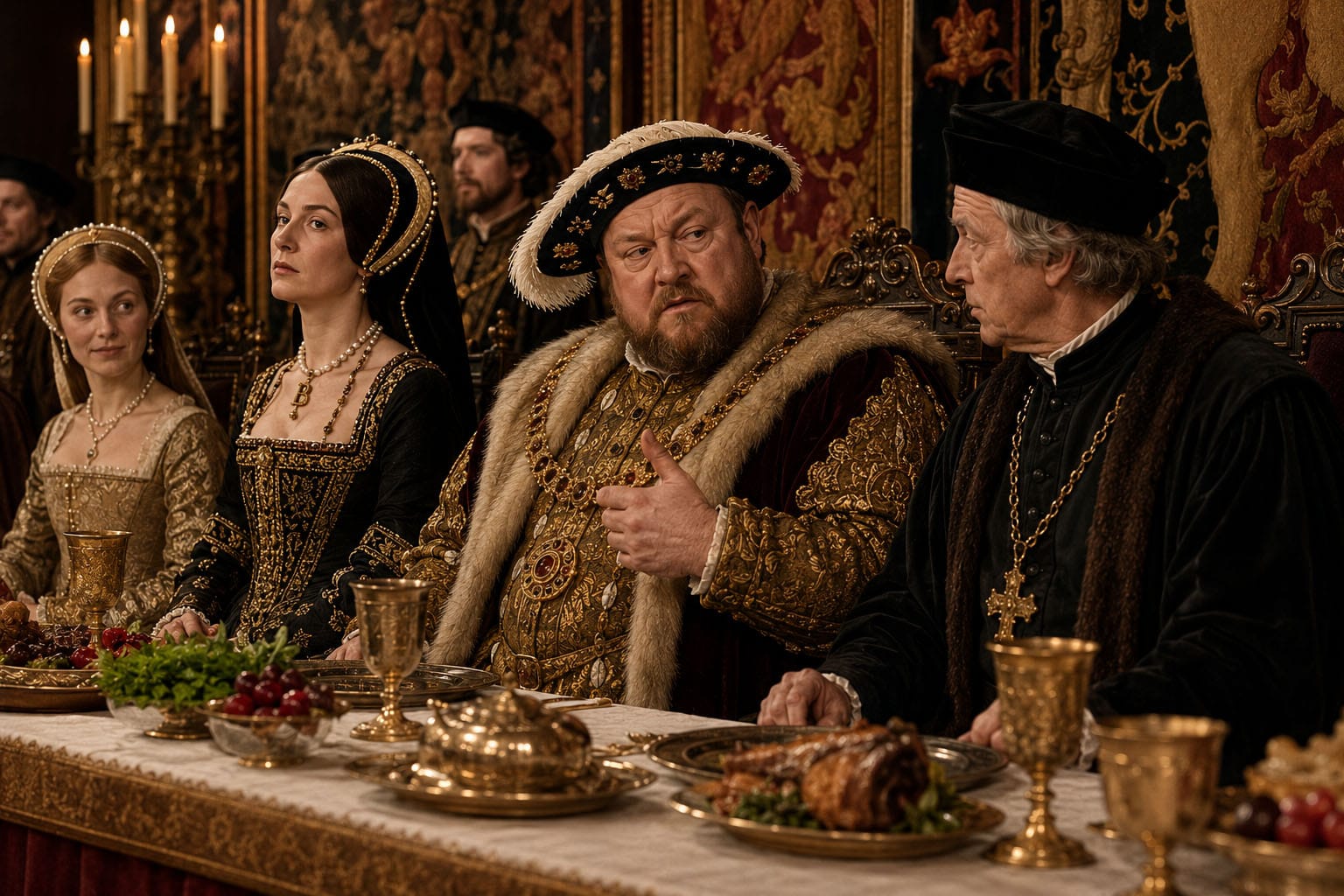
We move through time, subjectively. Time does not move.
Things Are Not What They Seem
If this is true, then every human moment continues somewhere within the architecture of spacetime.
Most of the time these moments remain inaccessible to us, separated by the ordinary operation of consciousness piloting through daily life.
Can, under unusual circumstances, within emotionally charged environments or states of altered perception, fragments become briefly perceptible?
Not the dead returning. Living moments still happening.
And does this possibility transform the meaning of haunting entirely?
It means at Hampton Court, Anne Boleyn or Catherine Howard may not be conscious spirits endlessly replaying their terror for spectators.
Instead, witnesses occasionally intersect with a moment of unbearable emotional intensity still embedded within the palace itself.
A scream still occurring.
This interpretation explains something traditional ghost theories often struggle with: why hauntings are so strongly tied to place.
If ghosts were merely surviving souls capable of movement, why remain confined to corridors, or staircases and rooms? Why repeat fixed actions?
Why appear unaware of witnesses?
But if hauntings involve intersections with preserved moments in spacetime, then location becomes essential. The event remains attached to where it occurred physically and emotionally.
The palace remembers what happened.
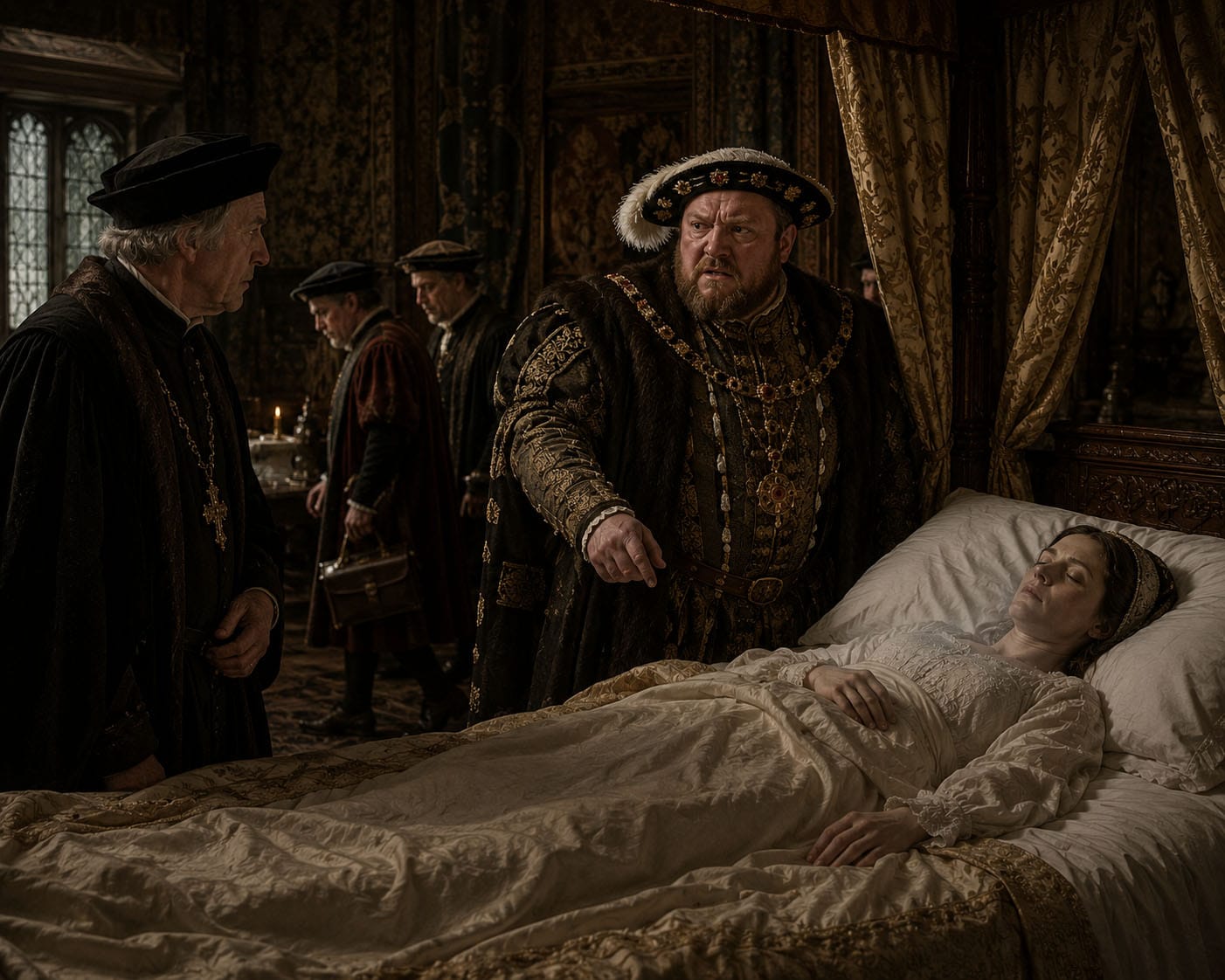
Tudor Stone Tapes
Hampton Court is exactly the kind of place where memory might accumulate with extraordinary density. For centuries it functioned as a royal residence, a stage for ceremony and echo-chamber of emotional pressure of highest society.
Every corridor channelled hierarchy and failure. Every chamber shaped behaviour. Fear and power of such intensity it wove into the stone and wooden frame.
Courtiers survived through performance and caution. Queens lived under constant scrutiny and deadly court intrigue.
Political fortunes rose and collapsed. Human emotion were rarely mild in those tapestried chambers. And perhaps intensity matters.
Modern neuroscience demonstrates that emotionally charged experiences create unusually durable memories within the human brain. Whether environments can preserve any trace of those experiences remains entirely unknown.
Nevertheless, the persistence of information elsewhere in physics encourages a question: might human experience leave forms of imprint we do not yet understand?
Related Essay
 Nick Hammond
Folklore and Physics
Ancient communities believed this.
Battlefields and prisons were rarely regarded as neutral spaces. They absorbed presence. Palaces too. They became spiritually or emotionally charged through repeated human experience.
Folklore across the world consistently treats architecture as capable of memory.
Mostly we in the modern world dismiss such beliefs as superstition.
Yet science increasingly reveals a universe in which information is persistent. Matter stores traces. Fields preserve patterns. Energy transforms but does not vanish. At quantum scales, observation itself appears entangled with physical reality in ways still deeply mysterious.
Does haunting belong somewhere within that unfinished understanding?
The Scream in the Haunted Gallery
Hampton Court’s long history of apparitional reports is compelling because witnesses frequently describe their experience as more than just vague shadows flitting through space.
It is a change in emotional atmosphere.
They describe a sense of sudden dread, or crushing sorrow; sometimes a sensation of urgency or panic.
These experiences often occur before any visible phenomenon appears.
This suggests haunting may involve more than visual hallucination. It may involve immersion within another emotional reality.
To encounter a ghost, under this interpretation, is to brush against another human moment so intense that it continues resonating across time.
Not simply seeing a dead person.
Same Place. Different Time
A surprisingly large amount of Wolsey's and Henry VIII's Hampton Court survives. Many visitors assume that Sir Christopher Wren's late-17th-century Baroque rebuilding swept away the Tudor palace, but in reality Wren only rebuilt about half of the complex.
The result today is a remarkable architectural hybrid: one of the largest surviving Tudor palaces in the world joined to a Baroque royal palace.
Hampton Court remains recognisably the same palace Catherine Howard once inhabited. The corridors and chambers survive; the geometry of movement flows as it always has.
Human beings still walk the same routes beneath the same ceilings.
Time anomalies appear far more frequently in environments where historical structure remains intact. On one level the building preserves its architecture, but perhaps it also acts almost as an anchor for moments themselves.
Fantasy and Reality
Scepticism remains necessary. Human perception is notoriously unreliable, open to influence of suggestion and expectation. Environmental factors and local storytelling shape experience.
Visitors to Hampton Court arrive prepared to feel something unusual. Psychological explanations are important and valid. But even scepticism leaves big questions unresolved.
Why do certain locations repeatedly generate similar experiences over centuries?
And why do apparitions so frequently behave like fragments of something still happening, and not autonomous personalities?
What is More Disturbing Than A Ghost?
Is the idea of ghosts trapped in time more disturbing than traditional images of the dead? Because this threatens our deepest assumptions about reality?
We comfort ourselves by imagining the past is safely concluded. The dead are gone. Moments vanish into nothing. History ends with now.
Places like Hampton Court suggest otherwise.
They imply that moments of human existence may continue somewhere beyond our ordinary reach, still unfolding endlessly within the deeper structure of reality.
Under rare conditions we glimpse them briefly, as overlap not fantasy.
A corridor where fear still runs. A scream still sounding silently through stone. A queen still trying desperately to reach a king who will never save her.
If so, then ghosts are not intruders from another world.
They are evidence that the world we inhabit may contain far more time than we are capable of perceiving.
And in old places heavy with history, like Hampton Court Palace, those hidden layers sometimes draw close enough for us to feel them beside us.
Topic Hub: Time Anomalies