What Are Ghosts? Spirits, Psychology or Glitches in Time?
Are ghosts spirits of the dead, or glitches in the "matrix of reality" - odd misalignments in our perception of time? What do we currently know and believe about the paranormal?

Things We Know and Don't Know About Ghosts
People have been trying to explain "ghosts" for thousands of years, longer than anyone can remember. Explanations fall into two main categories:
Folklore and spiritual beliefs. Or scientific psychological interpretations.
Folklore
Spirits of the dead is the most widespread idea. They are paranormal. Ghosts are the souls of people who didn't move on after their end of life. In many traditions the causes are echoes of unfinished business, trauma or sudden death that traps a spirit.
This idea is evident in everything from medieval ghost stories to modern paranormal TV. Ghost hunters popularise the idea of spirits lingering in locations.
Science claims there is no verifiable evidence that consciousness survives death in a form that can interact with the physical world.
It is also true to say that consciousness, how and why it exists and works, remains unexplained.
The "Stone Tape" Theory. Residual Hauntings.
Imprints. Stone Tape theory suggests events, especially traumatic ones, are recorded into environments and replay like a loop.
For example footsteps are heard at the same time walking across a room every night, as reported in the old Sun Inn building in Newport's Holyrood Street. Or the figure in white seen gliding down the so-called Haunted Gallery in Hampton Court palace in London.
These loops are often linked to old buildings and battlefields.
Science asserts there is no known physical mechanism for walls or objects to "store and replay" any such complex human sensory experiences.
Poltergeists, or Psychokinetic Energy
Poltergeist activity, such as noises and moving objects is sometimes attributed to spirits, or unconscious psychic energy from living people; often adolescents under stress. This theory blends folklore with pseudoscience.
Science claims there is no reliable evidence for psychokinesis. Many famous cases were later exposed as hoaxes or misinterpretation.
Ghosts Around the World
Different cultures explain ghosts differently. Some regard them as ancestors watching over the living. Others in Asia explain them as restless spirits requiring rituals. Some religious traditions describe these separated consciousnesses as demonic or deceptive entities.
These explanations may reflect cultural values more than observable phenomena. They are meaningful socially but not testable in a scientific sense.
Scientific and Psychological Theories of Ghosts

Sleep Paralysis & Pareidolia (Pattern Recognition)
Science offers a number of theories to explain ghosts.
Sleep Paralysis: People wake up, unable to move and may see figures or feel a presence. This often involves "shadowy beings" or pressure on the chest. Historically such cases are linked to "night demons" or ghosts.
This is well-documented, and science claims is reproduceable; and explains a large number of bedroom ghost encounters. "I woke up and saw someone stood at the bottom of my bed," complaints may be explained by this strictly biological state.
Or Pareidolia. A term that explains how our brain is wired to detect faces and patterns, even when none exist. This includes seeing faces in shadows, and hearing voices in random noise.
Pareidolia is regarded as highly credible, and explains many sightings, claims science; especially in low-light and ambiguous environments. Middle of the night, sleep-blurry eyes; what looks like a ghost really is only a shadow.
Infrasound, Low-Frequency Vibrations & EMF
Another theory comes from tests confirming sound waves below human hearing can cause anxiety and unease; even visual distortions due to eye vibration.
Some "haunted" places have natural or mechanical sources of infrasound.
This physical explanation for ghostly phenomena doesn't create full apparitions but can make people feel like something is there.
High exposure to EMF, electromagnetic fields, also has been linked to, controversially, paranoia and "seeing things"; or feeling a sense of "presence".
Science cites some experimental support for this theory but it is inconsistent. EMF might contribute to unusual sensations but it doesn't explain complex ghost sightings.
Related Essay
 Nick Hammond
Memory, Suggestibility & Environmental Factors
Human expectations shape perception. If we are told a place is haunted, we are more likely to interpret ambiguous stimuli as paranormal.
If we are in a "haunted" building with other ghost hunters, group psychology is known to sometimes amplify experiences.
This is a strong explanation for ghosts. Human perception is not objective, it is heavily influenced by what we believe and where we are.
Environmental factors can be influential, too. Carbon monoxide exposure is sometimes linked to hallucinations; as are the subtle effects of airborne mould and toxins.
Architectural systems can cause "ghostly "effects. Flickering lights and old wiring noises can seem and sound very spooky. These can cause very real, very disturbing experiences that feel paranormal but have entirely natural causes.

What Science Explains and What it Doesn't
Folklore theories are compelling stories, but lack testable evidence.
Scientific explanations don't explain every single reported detail but they explain many cases without needing the supernatural.
Current scientific understanding suggests that the more controlled and investigated a "ghost" case becomes, the more likely it is to have a natural explanation.
No ghost ever has been reliably recorded under controlled conditions, or measured interacting with physical systems in a repeatable way. There is no independent verification beyond anecdotal reports.
No ghost has ever appeared long enough to answer questions from the media.
From a scientific standpoint there is therefore no solid evidence that ghosts exist as spirits of the dead. But science points out there is strong evidence that humans can experience extremely convincing "ghost-like" events naturally.
From a human standpoint ghost beliefs persist because they connect to grief and memory; to our fears and need to find meaning.
Ghosts as experiences are absolutely real. Ghosts as external supernatural entities remains unproven. This is the tension between perception and reality.
Ghosts and Time
Most discussions about ghosts assume only two possibilities: spirits of the dead or mistakes of perception. Modern ideas about time suggest a third possibility. What if some hauntings are neither supernatural nor imaginary, but brief encounters with moments outside our normal experience of time?
Modern theories of time offer a different perspective on the subject of ghosts.
Most of us in the everyday world work on the standard assumption of linear time. It flows from past to present into the future. Yesterday no longer exists. So, ghosts cannot be the past, there is no past. Only the ongoing "now" of time's arrow tip.
Under a strictly linear view of time, ghosts cannot be echoes of the past. They must be either surviving consciousness, supernatural entities, or misinterpretations of ordinary events.
Or hallucination.
The Block Universe Theory of Eternalism
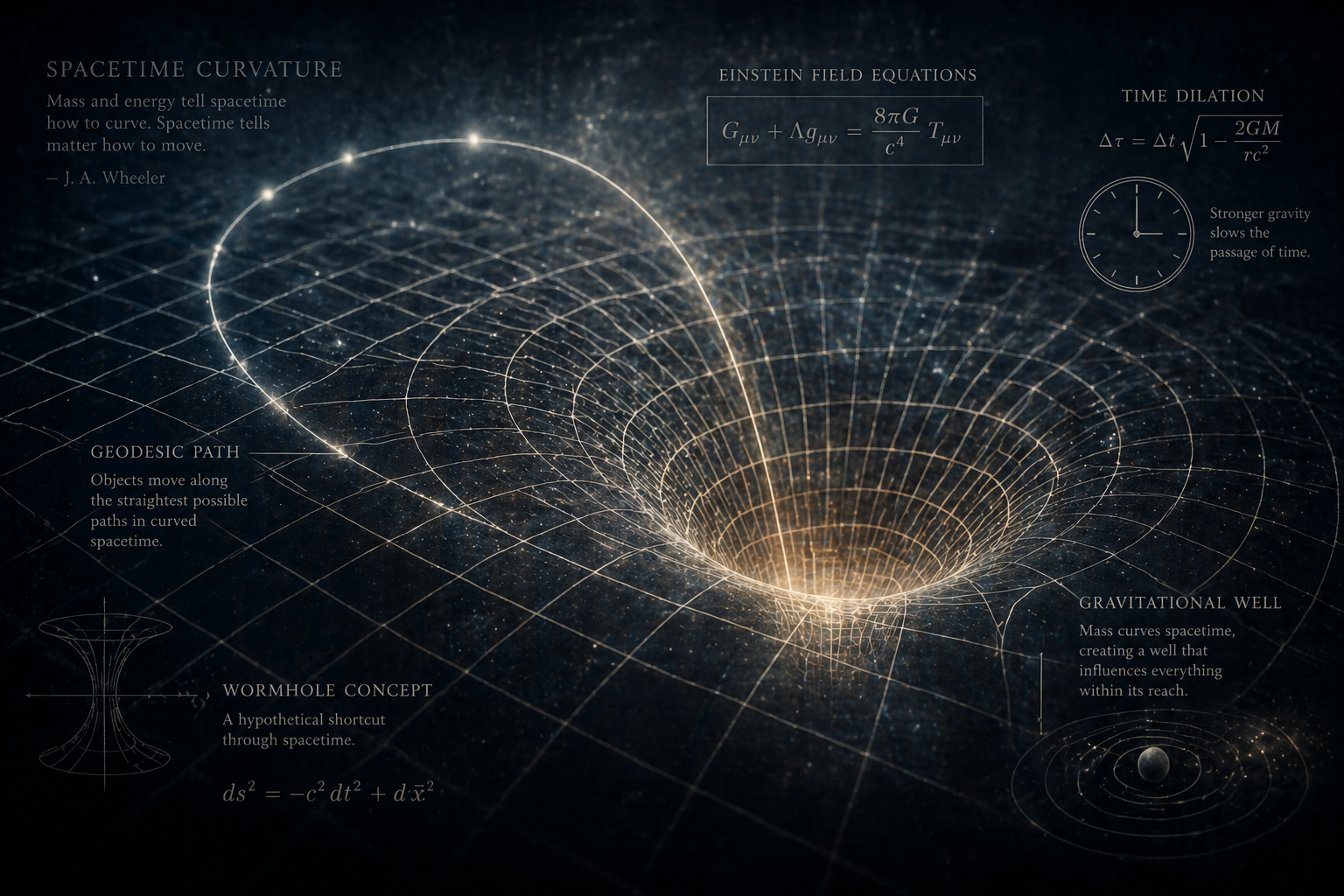
From the Theory of Relativity comes a different idea: past, present and future all exist simultaneously. Time is a landscape, not a flow.
Block Universe Theory proposes that reality is a "4D block" where 1820, 2026 and 3020 all coexist.
In this model a ghost can be a moment from the past leaking into the present. Or us briefly perceiving another "slice" of time.
This theory aligns well with residual hauntings, and repeating apparitions doing the same thing but does not allow for interaction between different "time slices". Nor is there any mechanism to explain the cause of leaking between moments.
This theory fits the idea of ghosts, but physics doesn't support the effect.
Time Loops, or Replay Phenomena
Another time-based theory suggests that certain events get "stuck" and replay like a glitch or loop in spacetime. Those eerie footsteps heard at the same time every night, the ghostly figure seen drifting along the same corridor repeatedly.
This is a more sci-fi version of the "Stone Tapes" idea.
However, there is no evidence for time loops at human scales. Time loops appear in theoretical physics - closed time-like curves - but only under extreme conditions, like in Black Holes and exotic matter. Not in everyday environments like houses.
Are We Consciousness Moving Through Time?
A separate but equally mind-bending theory is that time does not move, we move through it. We are consciousness moving through time; our brain jelly constructs the present "now".
Memory is literally our stored past experience.
In this theory a ghost might be a misfired memory reconstruction, a brief compatibility issue. Or instances of our brain blending past and present; which explains the strange familiarity of deja vu experiences.
Or those stronger trauma flashbacks that hold such vivid sensory recall.
This explanation is plausible and psychologically well-supported. Those in favour claim it explains why ghost sightings feel real; and why they are tied to emotional locations.
But it doesn't explain shared ghost experiences.
Many Worlds Interpretation, or Parallel Timelines
Quantum mechanics presents a more complex model: every possible outcome exists in parallel universes. In this explanation a ghost could be a person from a slightly different timeline briefly overlapping with ours.
However, there is no evidence universes can interact, and even less evidence of crossover. Until evidence is found, this is more science fiction than science fact.
Time Perception Distortion
Time becomes more complex the more you try to drill into it. Is time even experienced consistently? Fear appears to slow it down; repetition seems to speed it up. The brain can and does misorder events.
A "ghost encounter" could be the brain stitching moments together incorrectly, creating the illusion of something external.
This theory is strongly supported by neuroscience because it explains fleeting apparitions; movements in peripheral vision. Explains certainties such as: "I swear I saw something there a second ago."

Summary. What Are We Seeing? What is a Ghost?
From a scientific perspective, many ghost experiences can be explained through perception, memory and expectation effects.
One interpretation favoured by some paranormal researchers is the Block Universe model of time, which appears to fit reports of residual hauntings.
Least supported is the Time Loop in everyday environments, that parallel universes overlap.
Time-based explanations don't prove ghosts exist but instead of wondering if ghosts are real, maybe we should be asking: are we always seeing the present clearly?
Ghosts may be real but not in the way we think.
They may be echoes, overlaps. Misalignments in time perception. Maybe the past doesn't disappear, it just becomes inaccessible.
But some places make it briefly accessible again.
Topic Hub: Time Anomalies