The loss of Quarr Abbey to the community is a distant memory, the pain of social catastrophe is forgotten. Or maybe it isn't. A final funeral refuses to fade, its only clue is a white flowered coffin.
The Eternal Procession
Quarr Abbey's greatness has largely vanished from history. Yet one remarkable witness account suggests that something may still remain. During an investigation recorded in the Margo Williams archive, Williams and another witness described seeing a funeral procession of brown-robed monks emerging among the ruins. The coffin they carried was completely covered in white flowers.
Perhaps this is a clue to the occupant, but it also raises an important question that has fascinated humankind seemingly forever: who decides who deserves to be remembered?
An Abbey Lost to History's Gaps
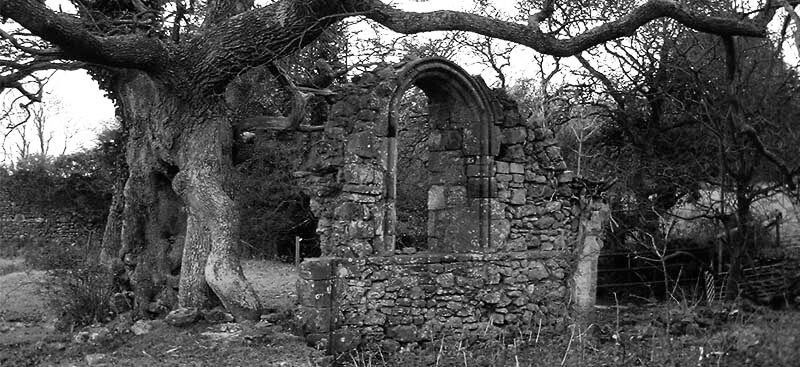
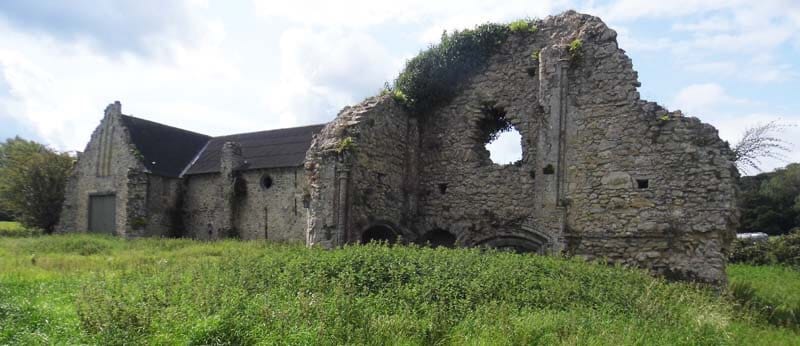
A few chunks of stone remain to tell of the skill of Quarr Abbey's architects, a thousand years ago. Grass grows where once stood the chapel and the sacred choir. Outside, its carefully tended complex of kitchen herb and healing gardens now are entirely lost to grasses, Ox-eye daisies and Ragwort.
Founded in the year AD 1132 Quarr Abbey derived its name from the quarries (De Quarrariis) in the neighbourhood. The stone from Binstead and Quarr was once highly valued and can be seen in many church structures in southern England.
The best part of 30 acres were included within the abbey walls, beyond was a vast forest to eastward, to the west woodlands sloped down to the Wootton river.
In 1148 Quarr became a Cistercian house, the second established in England. The Cistercian order, founded in the 11th century was strict: wearing neither skins nor shirts, they ate no meat, eggs, milk or cheese; they slept on straw beds and observed in all their religious exercises, a determined silence.
In 1340 the abbey was fortified and its grounds enclosed by strong walls with loop-holes and portcullises at its gate. But no foreign enemy broke its defences.
Quarr Abbey closed on the 22nd of July 1536. It became the property of King Henry VIII. Captain of the Island, Richard Worsley of Appuldurcombe was appointed as the King's Commissioner for the Sale of Church Plate.
George Mills and son, merchants of Southampton purchased the abbey site and broke it up.
Lord Baldwin's Abbey
Archaeological finds surfaced at various times, coins and other relics but not enough to throw useful light on the abbey's history.
Quarr's past is buried in obscurity, except for notes made by Sir John Oglander who visited the site in 1607 and asked the oldest folk he saw, what they remembered.
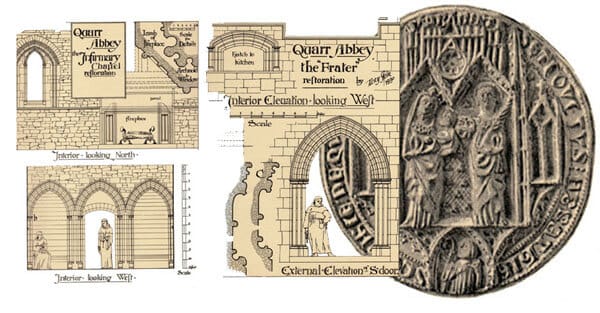
"Baldwin, the son of Rychard Rivors, who was Earl of Devonshire and Lord of the Isle of Wight, founded this Abbey and had fully finished it, and had the great church consecrated by Henry de Bloys, Bishop of Winchester and made a great and solemn feast there for the whole Island, for the finishing of so good a work, wherein every inhabitant in this Island was in something or other a helper and furtheror of the said work, on the first day of June 1150."
Quarr Abbey was founded by Lord Baldwin de Redvers, Lord of the Isle of Wight.
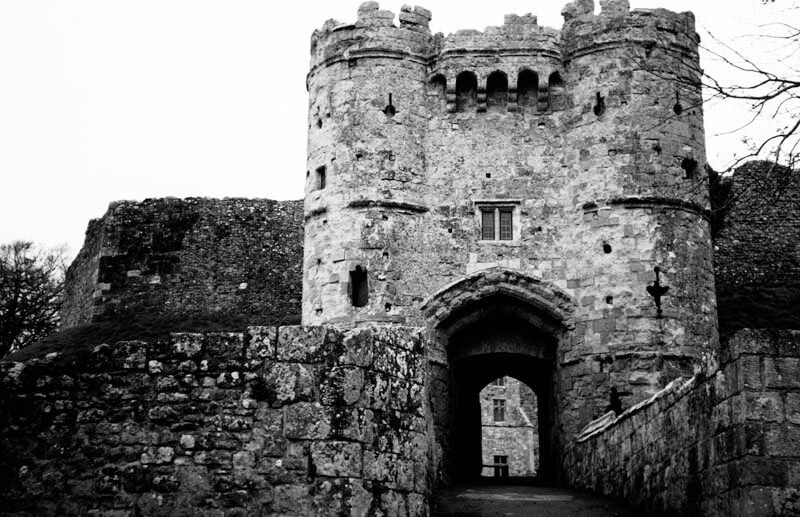
Baldwin founded Quarr only 66 years after the Norman Conquest. At that time much of the Island remained woodland, broken by small farming villages linked by rough tracks, rather than roads. Newport had not yet been established, Cowes did not exist and Carisbrooke Castle stood as the Island's principal fortress.
Perhaps no more than seven or eight thousand people lived here. Approximately today's population of East Cowes.
Most would never travel beyond the Island's shores. Their lord, however moved among kings and earls; governing the Isle of Wight as a small principality. While England drifted toward civil war, Baldwin sought something more enduring than politics could offer. He built an abbey.
The Abbey's Place in the Community
Baldwin's abbey was the beating heart of the Island community, everyone had a hand in building it. It provided employment, healthcare, food, housing; finance, education and hope.
And for anyone who thought it a good idea, the abbey listened to confession. For many Islanders Quarr stood at the centre of community life.
Oglander identified the year of Baldwin's death.
"This Baldwin died in the Isle of Wight in the year of our Lord 1155, and was the first that was buried in his great church at Quarr, where his funeral was solemnized by procession of the Abbot and monks; all the gentlemen of the Island attending on the corpse."
Sir John noted how Baldwin's son Richard built him a stately tomb near the high altar. "Now there is nothing left but ruins, except the cellar and buttery," Sir John sighed, and noted Baldwin was not the only VIP to be found in Quarr's holy ground.
"Goodly monuments in the great church certainly there were, but those of chief note was Baldwin, the first founder; Cicelye, the second daughter of Edward the fourth, who married for her second husband one Kyme, an Isle of Wight gentleman."
Born in the spring of 1469 Princess Cicely lived and died at East Standen, near St. George's Down. She was the second daughter of King Edward IV. Her sister Elizabeth married Henry VII, Tudor father of the abbey's destructor.
Henry VIII may have known his aunt lay buried in Quarr's graveyard.
Now no one knows who and where anyone might be interred, but occasionally someone is found.
Lord Baldwin Resurfaced?
History has a sense of symmetry. Richard Worsley helped oversee Quar's destruction. Three centuries later, just as the Worsley family finally disappeared from Appuldurcombe, reports emerged that the forgotten founder of Quarr may have been rediscovered beneath the earth.
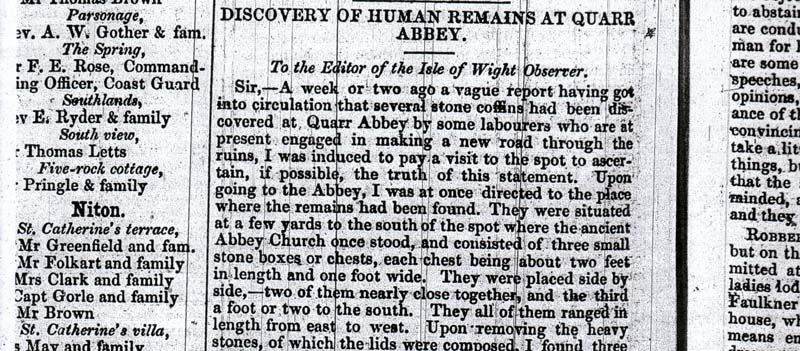
Three hundred years later labourers digging a road uncovered three small forgotten stone boxes. The monuments had vanished, the names were lost. The workmen reported that the skeletons found inside had been arranged respectfully, but they looked like an elderly man, his wife and a younger male.
Baldwin invested immense wealth in the hope that future generations would remember him. He believed a magnificent abbey would preserve his memory for ever. His descendants built him an impressive tomb beside the high altar. Henry VIII's commissioners destroyed it along with his memory.
The Worsleys believed Appuldurcombe would preserve their own dynasty.
Nothing proves the two events were connected, but it is one of those coincidences that history occasionally offers, inviting reflection. Without demanding belief in such a thing as a revenge completed "beyond the grave".
 Nick Hammond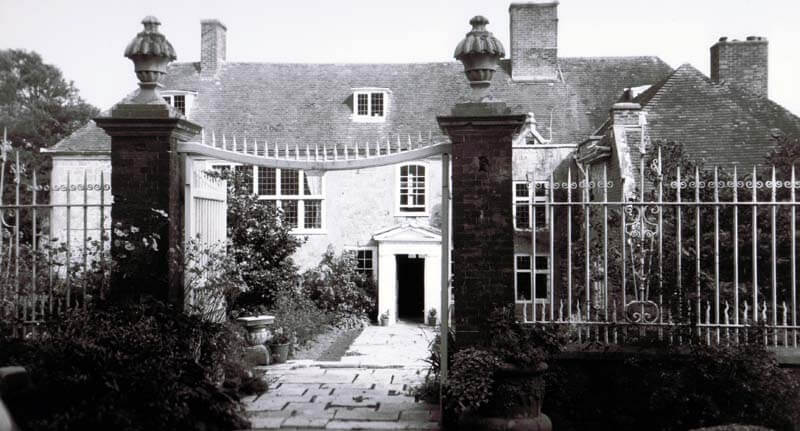
Remembering the Forgotten Catastrophe
Quarr was not just Baldwin's abbey, it was everyone's abbey. It belonged to the Island. Its loss was a collective trauma. The abbey had fed the poor, tended the sick, lent money to those in need.
When it closed those services vanished almost overnight. The Dissolution transformed Quarr's buildings and the social fabric of the Island.
That change is now complete and long forgotten. The daisies that grow over the abbey's old graveyard sway in the summer breeze undisturbed by desperate hunger and fear. So why does the site remember a funeral?
The Margo Williams archive records the extraordinary claim: that brown robed monks still carry a white-flowered coffin across the old abbey grounds towards Quarr's burial place.
We never will know who lies beneath the flowers.
The historical Baldwin's funeral is recorded by Sir John Oglander "solemnised by procession of the Abbot and monks." Eight centuries later, the Margo Williams archive records a claimed vision of a procession of monks carrying a coffin.
Whether the two are connected cannot be demonstrated, but they echo across eight centuries in a way that is difficult not to notice.
Baldwin built Quarr to preserve his memory. The monks prayed for everyone's memory. Henry VIII destroyed the monuments that preserved Baldwin's memory. The Worsleys may have inherited the consequence.
Today we no longer know whose funeral we are witnessing. History has levelled them all. The coffin could contain a lord, a princess, an abbot or an ordinary monk, and the procession is equally solemn.
The greater mystery is why, after so many centuries, one funeral should still be remembered when the lives of countless others have been forgotten?
Perhaps the procession is less concerned with who lies beneath the flowers than with reminding us that every remembered life stands among thousands now entirely forgotten.
Medieval society invested immense effort in remembering the dead through monasteries, prayers and monuments. The Dissolution swept much of that culture away overnight.
The procession preserves not so much the possibility of a ghost as the idea that some lives, and perhaps some communities, continue to ask not to be forgotten.
What Time Presents
Time rarely preserves complete memories, more often it leaves us fragments: a ruined window; an old chronicle; a forgotten stone coffin; or a handful of white flowers whose meaning almost has been lost.
Baldwin hoped his abbey would preserve his memory. The monks prayed for everyone entrusted to their care. Henry VIII believed he could decide whose monuments survived. The Worsleys believed Appuldurcombe would preserve their own dynasty.
Baldwin's story survives. The abbey survives. The Worsleys survive.
Just not in the form any of them intended.
 Nick Hammond