Knighton Gorges no longer exists; its stones were carted away more than two centuries ago. Yet witnesses continue to report sounds of celebration, racing carriage wheels and, occasionally, the house itself.
How do you haunt a house that no longer exists?
Knighton Gorges house, once described as the "most considerable and beautiful of the ancient mansions of the Island" now is bare ground.
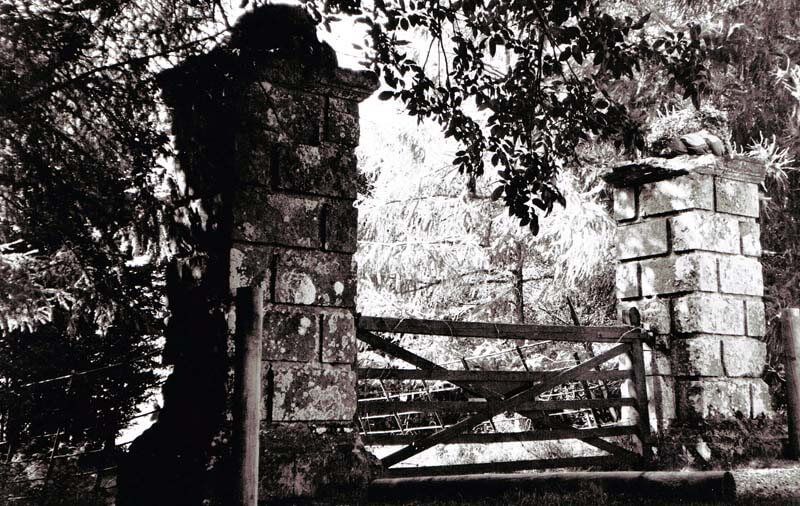
All that remain visible are its gatepost pair.
But sometimes it reappears, together with a horse and carriage driven by a headless coachman. Accounts of which can be found in Gay Baldwin's excellent books on Isle of Wight ghosts.
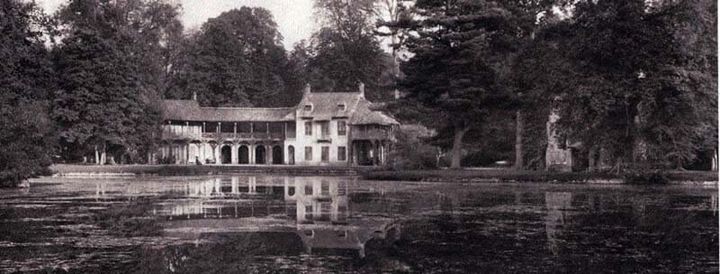
Knighton Gorges Before Destruction
Some references describe the old manor house. Leigh Richmond, Island author of "The Dairyman's Daughter" wrote:
"The manor house had evidently descended through a long line of ancestry, from a distant period of time. The Gothic character of its original architecture was still preserved in the latticed windows, adorned with carved divisions and pillars of stone work.
Richmond described how one end of the house was entirely clothed with thick foliage of an immense ivy up to the summit of its tall chimneys.
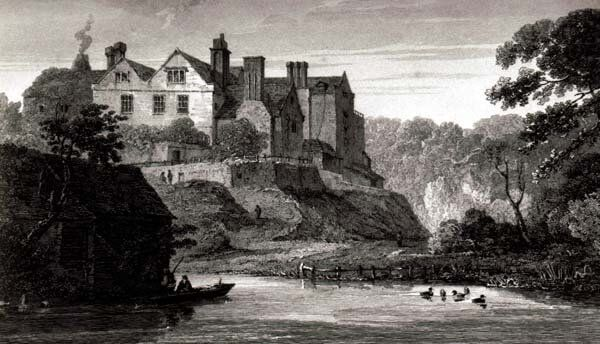
Island antiquarian Wyndham described the position of Knighton Gorges house:
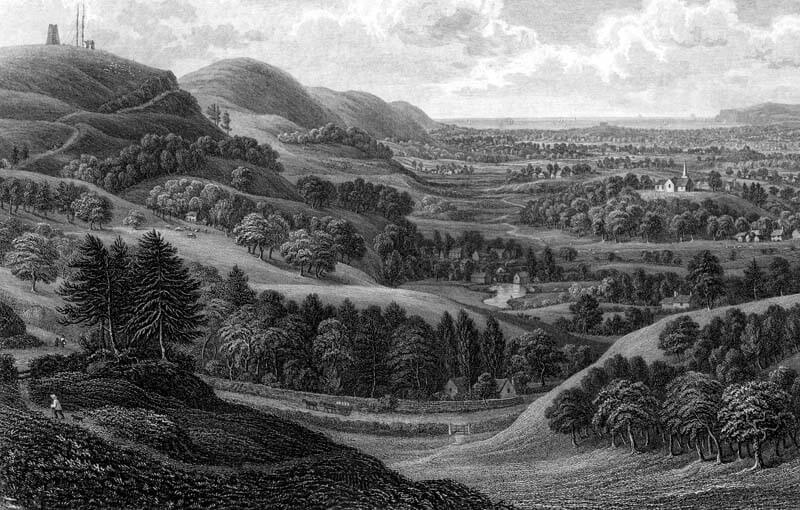
"Though it appears from the hills above to be fixed in the abyss of a valley, yet commands an extraordinary prospect that is still much lower than the house.
Viewed from below, it exhibits its picturesque site, deeply embosomed in well-timbered woods, which rise on the east and west sides, in steep acclivities to a height almost equal to the Down"
Sir Henry Englefield also noted that the old manor house had a "fine grey tint and a glowing yellow ancient moss-tiled roof." Inside, Sir Henry saw a spacious drawing room and a long gallery through the centre of the building.
All of which was lost on the order of its last owner, Maurice George Bisset. In later life George Bisset became increasingly bitter and eccentric. After a family dispute he moved into his gardener's cottage and ordered the manor house dismantled stone by stone, rather than allow his niece and her clergyman husband to inherit Knighton Gorges.
A Reputation for Strange Events
The house did have a "history" of unusual activity. It contained a wood-panelled room, named by residents as "The Room of Tears". A room regularly disturbed by unexplained disturbances, sometimes accompanied by what sounded like clanking chains and supernatural sobbing. A room mostly kept locked.
Folklore attributed these disturbances to its earlier owners.
Knighton Gorges stood on the footings of an older building belonging to a famous Island family, the de Morvilles. One explanation for the haunting centred on a member of the family, Hugh de Morville, remembered as one of the four knights involved in the killing of Archbishop Thomas Becket in 1170.
Local tradition claimed the sounds of chains heard within the manor were his punishment, replayed across the centuries. Whether the story was medieval folklore or later invention is impossible to know.
Local legend claimed a Latin curse was etched above the doorway to keep inside its dangerous spirit.
The Dillington Disaster
House ownership passed from de Morville's family into the de Gorges; then the Russells into the Gilberts, then into possession of the Dillington family in 1563.
Later generations linked the locked room to Sir Tristram Dillington, whose death became the subject of local rumour and speculation.
Gay Baldwin offers two versions of the fate that befell Sir Tristan. One describes how in 1721 distraught by grief at the fever that caused the death of his wife and children, Sir Tristram took his own life. The alternative is less melodramatic: he had no children, suffered depression and ill-fortune as a gambler, and at the age of 43 the lonely bachelor jumped into the Knighton pond, or pointed a pistol at himself.
According to legend his steward strapped Sir Tristram to his horse and drove it into the pond to claim he must have drowned by accident, and so avoid the need for inquest and the Crown seizing the estate. That deception saved the manor for his sisters to inherit.
The Ghosts of Knighton Gorges
Baldwin notes how after Sir Tristram's death, sightings of a spectral hound and a headless horseman were reported. From inside the sealed Room of Tears came the sound of supernatural sobbing.
During the centuries since, on the anniversary of his July suicide, he sometimes is seen driving a carriage pulled by four horses. Baldwin notes the sightings, "half a dozen in the last 50 years."
The final two ghost sightings are the most dramatic.
Baldwin relates how on New Year's eve of 1915 Island travel books author Ethel C. Hargrove and a friend visited the site, and saw Knighton Gorges restored. They too saw its lights, heard the sound of carriages and hounds; saw a figure in Georgian period costume raise a glass in toast.
Ethel's experience is quoted at length:
"A few minutes before midnight a flood of melody arose from the site of the former mansion. It was varied in character, dance music played on a harpsichord.
Georgian minuet airs, slow and stately, then a duet between tenor and soprano voices. At twelve the party seemed to break up, a pistol or gun was fired, dogs bayed, and the sound of carriage wheels was heard."
Baldwin also mentions an anonymous local account which includes a drive-by carriage sighting. The strange story is told by elderly locals who related how an eye-witness reported another full sighting of the house.
The witness stood at the gates looking up at a big house, when a horse and carriage at full gallop careered past, knocked the young man into the ditch. He picked himself up and chased after the reckless carriageteer.
Chased all the way to the big house and hammered on the door. No answer. Tapped on the window, he saw between the curtains a fancy-dress party in full swing, Georgian wigs and dandies fopping and dancing to music.
No one answered the summons so the witness walked away up the road to nearby Newchurch. He knocked on a door, found welcome and a hot meal. He told the friendly hostess and her husband about his near-miss up by the old gateposts, how he saw a party of gentry inside the big house.
"Which house might that be?" asked the hostess.
The visitor carried a tourist map and showed her.
"No house there, not for many years," she said.
What makes these accounts unusual is that witnesses were not merely seeing people, they were reporting the return of an entire vanished landscape.
Ghost or Time Slip?
Most hauntings involve seeing a person. Knighton Gorges is different, witnesses reported seeing an entire building, complete with lights, music and occupants.
If the account is accepted at face value, the phenomenon resembles what researchers sometimes call a time slip: a brief overlap between different moments in history.
Rather than a ghost inhabiting a ruined landscape, observers may have experienced the landscape itself as it once was.
Given the long history of Knighton Gorges house, we must ask why the horses and carriages, and the Georgian party? What is it about that period and its party that is being remembered?
Why does the house appear repeatedly as though still standing?
The House and the Mystery
The destruction of Knighton Gorges is central to the mystery. Had the house survived, a report of a Georgian party in the windows would be unremarkable.
It is precisely because the house was demolished that the account becomes extraordinary. The disappearance of the building creates the anomaly.
Can a place continue to exist after it has been destroyed? Not physically, of course, but as some kind of residual historical reality occasionally perceived by later observers.
Knighton Gorges is gone; its materials were carted away, some of its interior accommodated elsewhere more than two centuries ago. Yet witnesses continue to report sounds of celebration, carriage wheels and, occasionally, the house itself.
If ghosts are memories of people, Knighton Gorges presents a different possibility.
Perhaps places remember too. And sometimes, for a moment, the past becomes visible again.
The "ghost" of Knighton Gorges is arguably not a person at all. The ghost is the house itself.
 Nick Hammond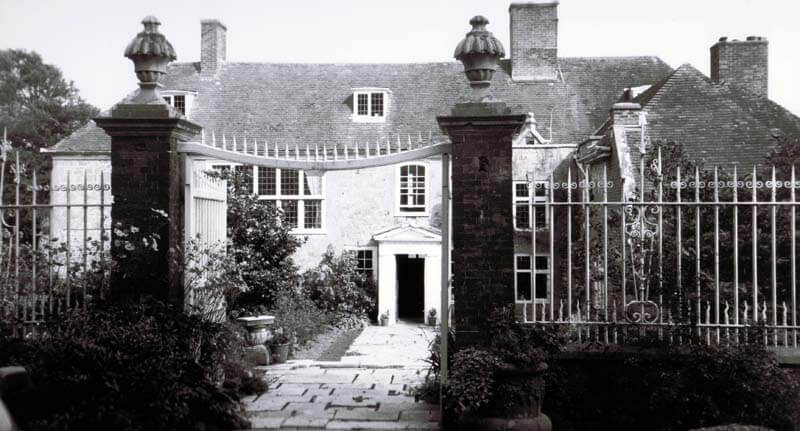
 Nick Hammond