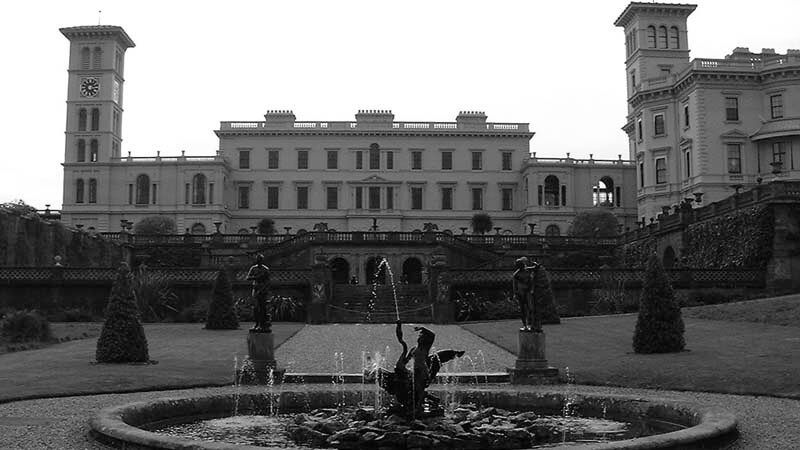
Osborne's greatest haunting is the lingering presence of an age that believed that Britain ruled the oceans. The Empire has vanished from the world, yet here it survives compressed into one extraordinary house on the Isle of Wight.
A Home Frozen in Time
Is there a time to let the past end? If there is, it isn't at Osborne House.
After Prince Albert's death during the winter of 1861, Queen Victoria refused to let the rhythms of daily life change. His rooms remained ready for his return; his possessions stayed where he had left them. The house seems to have joined her act of remembrance.
Perhaps its ghosts are another expression of that refusal to let go.
Osborne is often described as Victoria's favourite home. It is a memory palace. Behind its Italianate façade lies perhaps Britain's most complete surviving portrait of Victorian domestic life at the height of empire. Its rooms left almost untouched since Victoria died in 1901.
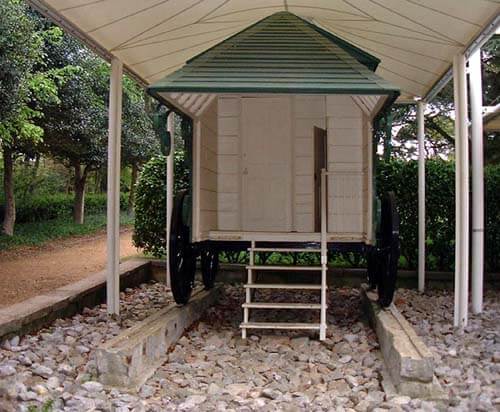
Gifts arrived from every corner of a vanished empire and, even today, remain where they were placed. Personal belongings still stand ready for use. Near the beach, Victoria's bathing machine still waits as though its owner might return tomorrow.
In a house so devoted to remembering, it is unsurprising that some visitors believe memories have learned to walk.
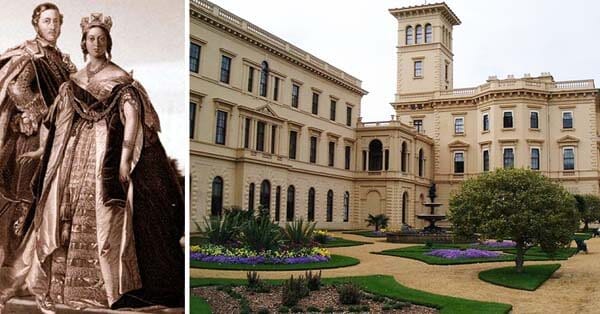
The Palace of Memory
Osborne House was a giant memorial before it became a museum. Nothing changed after Albert's death, everything kept as it was when he still breathed. Hot water still was brought to the bedroom; family photographs remained where they were. Every tiny object part of an act of remembrance.
Visitors to Osborne House step into the palace of an empress, and soon find themselves inside a memory. A treasure house filled with Indian gifts and African ivory. Woodworked carvings and statues in timbers from Canada and Australia; objects gathered from every continent.
The Empire has physically retreated and converged upon one small island in the English Channel. Even after the Empire disappeared politically, Osborne still preserves its material memory; like Pompeii preserves a moment of Rome.
In a place so devoted to preserving memory, there was bound to be a ghost story; or some memories acquiring a life of their own.
 Nick Hammond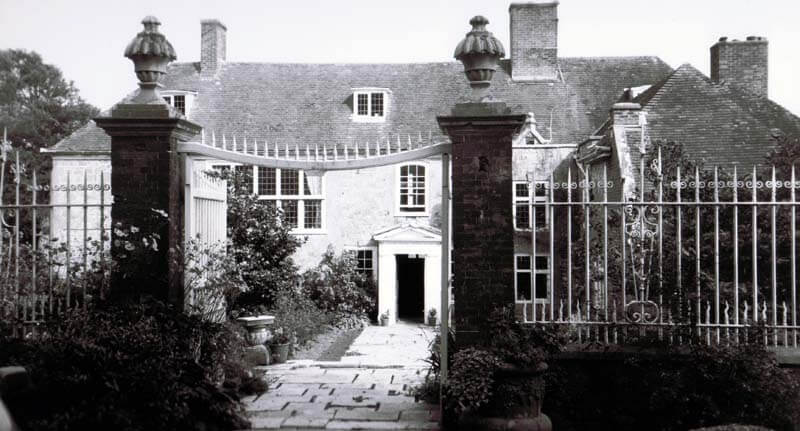
The Ghosts of Osborne House
Osborne House's ghost traditions are shaped by grief and the lingering presence of empire, and gold.
Tradition identifies the ghost responsible for mysteriously moving things as Mr Eustace Mann, searching for a map he lost after he stashed a horde of gold during the English Civil War.
Reports of paranormal activity usually describe a tall male figure in dark clothing. Clipped sounds of footsteps in otherwise empty corridors.
Other traditions tell stories of a female apparition seen in the royal bedroom, and sometimes outside, in the garden by the bathing machine.
But why should the ghost of a forgotten country gentleman survive when queens and princes lived here? History remembers Victoria; folklore remembers Mann.
Staff occasionally reported objects inexplicably changing position. Local tradition could not blame gentle wise and kind Albert for such mischief; or that Her Majesty might stoop to being spiteful. Everyone blamed Eustace Mann.
The Bathing Machine & the Bedroom
Visitors gaze upon this parked vehicle and see it as an interesting object. It is one of Osborne's great symbols. Almost a ghost.
A machine waiting for someone who will never return.
Victoria spent 40 years ensuring no one had to imagine Albert. His room functioned as a haunting. Victoria made his absence physically present.
Osborne does not need Victoria's ghost. She never left. Her handwriting is preserved along with her furniture and dresses; and the family and Empire photographs. She already is everywhere. Her ghost is almost inevitable.
Most haunted houses preserve a family. Osborne preserves an age. Visitors enter expecting to see Queen Victoria's home. Instead they find a civilisation suspended in time. Every room preserves another fragment of 19th century Britain.
Each is a memory of Victorian domestic life, and a nation's industrial confidence. In some it is imperial ambition, in others we discover our great grandparents' scientific curiosity.
Some palace rooms are vivid memories of family devotion and overwhelming grief.
Neptune's Heavy Weapon
The Empire has vanished. Victoria has been dead for more than a century. Albert even longer. Yet the house continues quietly remembering them all, and the deal that was made.
Almost nowhere else presents the Victorian world so vividly alive.
Above the great staircase inside Osborne is a giant canvas painting depicting a scene at sea. It features the Roman god Neptune resigning to Britannia the Empire of the Sea.
It looks like mythology. It is, political mythology. Neptune, the Roman god of the sea is acknowledging Britain's supremacy. He voluntarily hands Britannia the trident of maritime dominion. It suggests Britain's naval power is divinely sanctioned.
It looked unquestionably so. During Victoria's reign Britain possessed the world's largest navy, its greatest merchant fleet and an empire stretching across every inhabited continent.
The painting presents this historical circumstance as something approved by the classical gods. Timeless and inevitable. Like Rome before it, Britain used classical mythology to explain itself.
That painting tells every visitor: Britain rules the seas. Everything in the palace from every corner of the Empire supports that idea.
In some ways Osborne is a palace of imperial confidence.
Does Britannia Still Rule the Waves?
Few Victorians believed Neptune literally existed. They borrowed, because myth carries authority. Medieval kings justified themselves through Biblical imagery, 19th century Britain often justified itself through ancient Greece and Rome.
The painting says: Britain now inherits Rome's destiny. Even Neptune acknowledges that succession. It is political theology disguised as classical art.
Today visitors still climb the great staircase, but most carry completely different assumptions. The Empire has vanished; many commonwealth nations are fully independent. The Royal Navy is respected but vastly smaller than during Victoria's reign.
Britain continues to debate its role in the world after Brexit, changing alliances and shifting global power. The painting has not changed, but its audience has. It now is not so much a celebration, than a historical document revealing how Victorians understood themselves.
Victoria's monarchy was inseparable from empire. Today's monarchy represents something fundamentally different. Victoria became Empress of India in 1876 and reigned over roughly a quarter of the world's population.
Today's monarch presides over the United Kingdom and serves as head of the Commonwealth, a voluntary association, not an empire. The Crown has survived by changing its meaning. The staircase painting has not.
The house preserves an image of monarchy that no longer exists except within this remarkable preserved environment.
The Empire has become the ghost of Osborne House
The Ghost of Empire
In Greek and Roman mythology the sea belongs to Neptune. There is no record of anyone since who witnessed the handing-over ceremony into the grasp of mortal nations. There are only the facts of history and proof of empire's impermanence.
Spanish naval authority ended, as did Dutch. So did the British Navy's.
The ocean outlasts every empire.
Osborne House's ghost stories imagine Albert returning to his rooms and Victoria walking the terraces; and mostly blame Eustace Mann searching endlessly for the map to his lost treasure horde.
But Osborne's greatest haunting is perhaps the lingering presence of an age that believed Britain ruled the oceans. The house quietly preserves the moment before anyone realised the gift had always been temporary.
The house remembers a world that no longer exists.
 Nick Hammond