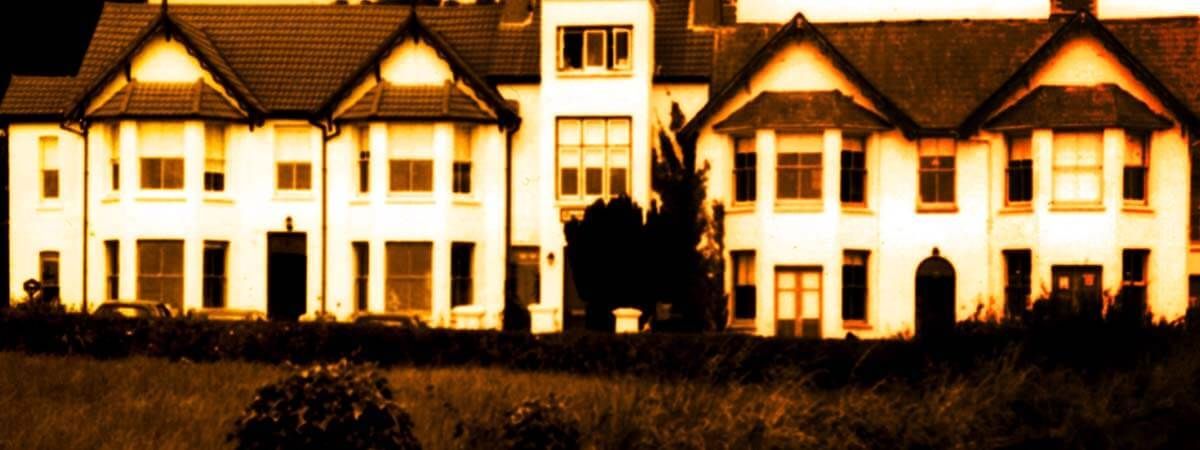
Some visitors to Dimbola Lodge Museum report the unexpected smell of long-vanished photographic chemicals, and wonder whether Julia Margaret Cameron still lingers where she once worked.
Is Photography A Form of Haunting?
What changed when humanity first learned to preserve a face forever?
Long after the photographic chemicals disappeared from Dimbola Lodge Museum, some visitors still report smelling them.
If true, what exactly remains?
The memory of Julia Margaret Cameron? Or the lingering echo of one of history's greatest revolutions: the moment humanity first learned to arrest time?
Before photography people disappeared. Their appearance survived only if someone had painted them or sculpted them. When the last person who remembered them disappeared too, all trace of what they looked like was lost.
After photography, ordinary people suddenly became permanent.
That astonished Victorians. Photography changed humanity's relationship with mortality. In fact post mortem photography blossomed in the rush to preserve the final appearance of a loved one before the casket closed.
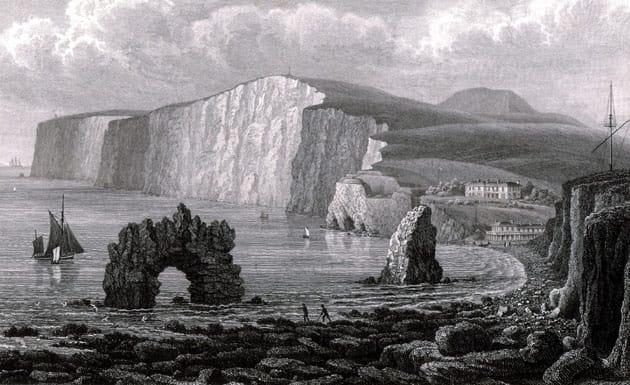
In Memorium
Julia Margaret Cameron was alive during the greatest intellectual upheaval of the 19th century. Within only a few decades, Victorians saw distance collapse beneath the railway and telegraph, cities transformed by industry, streets illuminated by electricity, and an empire that seemed without end.
At the same time, Charles Darwin challenged humanity's place in nature, archaeology was uncovering civilizations and histories that stretched far beyond traditional Biblical chronologies.
Spiritualism claimed communication with the dead. Rarely has a generation witnessed so many certainties dissolve at once.
Cameron's neighbour, Alfred Tennyson was pondering these very issues. His poem In Memoriam was written after the death of Arthur Hallam, a poem described as almost an extended meditation upon grief during the age of geology and Darwin.
Cameron explored through portraiture the same questions Tennyson explored through poetry: can faith survive science? Does love survive death?
She and Alfred together in different ways asked: can memory defeat time?
Tennyson's circle became Cameron's gallery. She persuaded poets, scientists, actors and visitors to sit before her camera, transforming living acquaintances into images that would outlast them all.
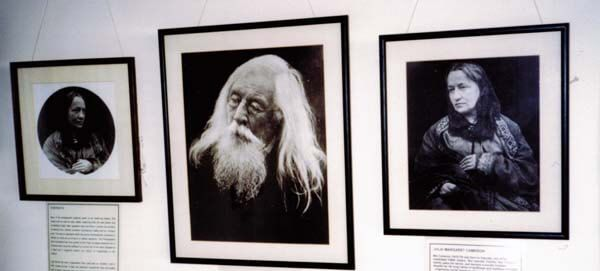
Julia Margaret. A Brief Profile
Born in midsummer of 1815 in Calcutta, India, Julia Margaret Cameron and her husband Charles Hay, moved to Freshwater from London in 1860.
Mrs Watts, wife of Victorian artist G.F. described Mrs Cameron so:
‘To all who knew her she was a unique figure, baffling all description. She doubled the generosity of the most generous of the sisters, and the impulsiveness of the most impulsive. If they were enthusiastic, she was so twice over; if they were persuasive, she was invincible."
Aged 48 she launched into her new career. The coalhouse became darkroom, and the glazed fowl-house her studio, the 'glass house' as she called it. She and the Alfred and Emily Tennyson were friends, so much so Alfred permitted her to persuade and even kidnap his house guests and visitors for photos.
Each portrait involved carefully coating the large glass plate, balanced between thumb and forefinger while delicately pouring over the Collodion to coat evenly.
The plate was then immersed in sensitising bath and then eased into the camera. The plate had to be kept wet for exposure.
With this in place, the subject in position, the lens ready for exposure for anything between three and ten minutes, a portrait began.
From two hundred and forty-five exposures only twelve met her high standard for Alfred's epic poem 'Idylls of the King.'
In 1875 she and her husband closed the doors of Dimbola and returned to Sri Lanka. On the quay side as their luggage was carried aboard ship, she handed out photographic prints in place of cash to tip the porters. 'Take these instead as a remembrance,' said she before the waters of the Solent carried her away to Ceylon where she died on January 26th 1879 at the age of sixty four.
Her last spoken word was "Beautiful".
The Age That Learned to Capture Time
To enter the darkroom in Dimbola must have felt like stepping into a dim world somewhere between the supernatural and an alchemist's laboratory. A darkness saturated with chemicals of acetic acid and silver nitrate; a dark place where faces emerged into glass, like ghosts.
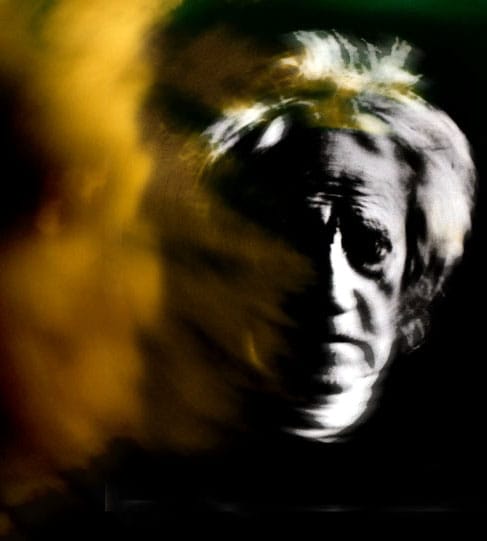
Photography was a pungent ritual performed to stop time itself.
Portraits had existed for centuries. Photography did something different, it preserved time itself. The face of a child. An aging parent. A poet, a labourer; a soldier. All could survive after death. This transformed memory.
Cameron was less interested in recording appearances than revealing character. Her softly focused portraits sought personality rather than perfect sharpness, giving many of them an almost timeless quality.
 Nick Hammond
Dimbola's Ghost
Dimbola now houses a permanent exhibition of Cameron’s work; and continues to be a world-class inspirational centre for the arts.
Internationally eminent artists and creative thinkers come to present talks and exhibit works; for Dimbola is one of the Island’s great art venues.
Visitors today occasionally report smelling photographic chemicals where none are being used today.
Are these merely remembered associations? Or has the place somehow retained the atmosphere of decades spent creating images?
Whether or not Julia Margaret Cameron still walks Dimbola Lodge is impossible to know. But every visitor encounters something she unquestionably left behind. Her photographs still meet our gaze across a century and a half, with extraordinary intimacy.
They remind us that every photograph is, in its own way, a conversation between the living and the dead.
If ghosts are memories that refuse to disappear, then perhaps every photograph is a ghost: a moment that has died, yet still looks back at the living.
 Nick Hammond