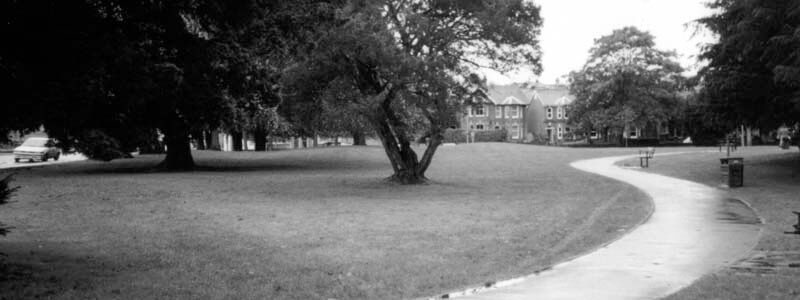
A bonnet-wearing ghost sometimes is seen wafting the paths of Church Litten park. A fashion accessory which dates her as a late addition to the old burial ground below.
Church Litten Park
Church Litten park is this peaceful open space of lush grass and shady trees in Newport town centre. In spring, summertime and warm autumn days it is vibrant with life, as townsfolk gather to enjoy this grassy oasis.
Young people plan futures, older people share memories. What rests below is forgotten.
Formerly Litten Park was St. Thomas' church burial ground. Before this - during medieval times - archery butts were located here. Bows long and short twanged and hummed and chances are sometime, someone missed the target but caused an accident.
Which is why some paranormal investigators assume the Litten Park ghost is from that period, but those who had a sighting describe a misted figure wearing an old-fashioned bonnet.
 Nick Hammond
The Old Burial Ground
The open ground of the archery range was repurposed during a plague outbreak in 1598. This deadly disease caused the loss of more than 200 Newport residents, too many to accommodate in the town's existing burial site in Carisbrooke churchyard.
The Litten, a Saxon word for 'burial ground', continued in use until 1850 when the graveyard was full. The council opened a new site, Mount Joy Cemetery. The Litten's funerary monuments were removed and broken up; names and epitaphs of the dead lost and forgotten.
The old graveyard transformed into the pleasure-garden it is today. Paths were laid and trees were planted. "Life is for the living," is the story of Litten Park.
But what about the dead who haunt the park as ghosts?
 Nick Hammond
The Forgotten Dead
The burial ground closure was a practical decision. Towns change and grow; space is needed for the living. Yet something curious happened during the transformation.
The people buried here slowly vanished from memory.
When laid to rest beneath the soil, each possessed a name, they had a family and a life-story. Some were prosperous, others struggled through hard lives. Children were buried here; grandparents too.
During plague years, the cemetery received Newport residents whose lives ended suddenly and unexpectedly.
Today most of their names are forgotten.
The bonnet-wearing ghost reported by some visitors presents a memorable irony. No one knows who she is. Yet she may be among the few former occupants of Church Litten still remembered at all.
Whether ghost, legend or imagination, the anonymous figure serves as a reminder that thousands of lives once passed through this place.
The Hidden City Beneath Newport
Modern Newport appears familiar and ordinary. People cross the park on their way to work; friends meet on benches; children play, and people picnic lunch.
Yet beneath these everyday scenes lies another Newport. There is no lost city of stone ruins and buried treasure, it is a vanished community.
Generations of townspeople once occupied the same ground. Where townsfolk and visitors now sit and eat lunch; families gathered to mourn, and clergy conducted burial rites. Gravediggers worked among rows of memorials. Funeral processions crossed these paths.
The modern town exists alongside an invisible predecessor.
Most historic towns possess such hidden layers. Buildings are demolished; streets change and memories fade. Yet traces of earlier lives remain in the landscape.
Church Litten offers a rare opportunity to stand directly above one of those lost layers and reflect on how many lives have unfolded in the same small piece of ground before our own.
Why Are Some Places Remembered?
Not every former cemetery acquires a ghost story. Many are forgotten entirely.
Yet certain places seem reluctant to disappear from memory. Stories gather around them; legends persist. New generations repeat old tales without always knowing where they began.
Sceptics might argue that once a location gains a reputation, visitors naturally become more alert to unusual sights and experiences. Believers may conclude that some part of the past genuinely survives.
Perhaps both explanations contain an element of truth.
Ghost stories often appear where memory and place overlap. They emerge around old battlefields, ruined houses, abandoned churches and forgotten burial grounds. Locations where human emotion was once concentrated and where traces of earlier lives remain visible, however faintly.
Church Litten may be one such place.
The bonnet-wearing woman is not a queen, a saint or a famous historical figure. She appears instead as an ordinary resident of Newport, someone whose memorial has vanished but whose story, in some form, may continue.
If so, her significance lies not in who she was, but in what she represents.
A reminder that beneath the grass and trees rests an older community whose lives mattered just as much as our own.