Science obeys laws of mathematics, nature follows laws of the jungle, but does history follow a hidden law that governs how we will be remembered?
The Castle, the Clock, & the Marble Face
Many of us wants to leave some mark upon the world. Remind the unknown future that we were here. Those with greater resources imagine bigger projects. It is the same in the Isle of Wight coastal town of Yarmouth as anywhere else.
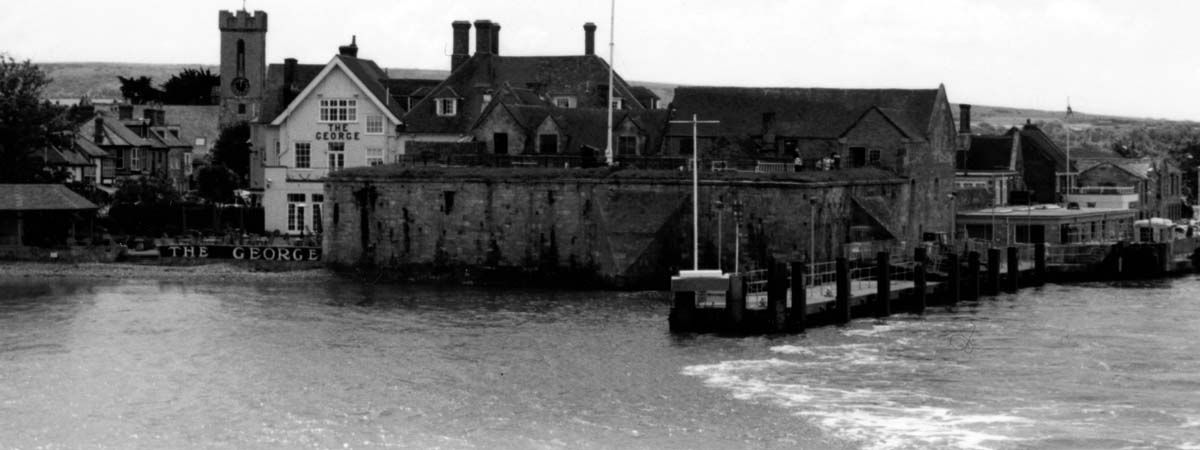
Architect Daniel Alexander restored the town church and extended its tower by 30 feet and left us with a clock. Henry VIII built a gun fort to protect the town's future and left us with a castle. Sir Robert Holmes strengthened the town's defences and left the people of Yarmouth a marble face on the body of a king.
Together they suggest a peculiar law of history.
A Defence Against the Future
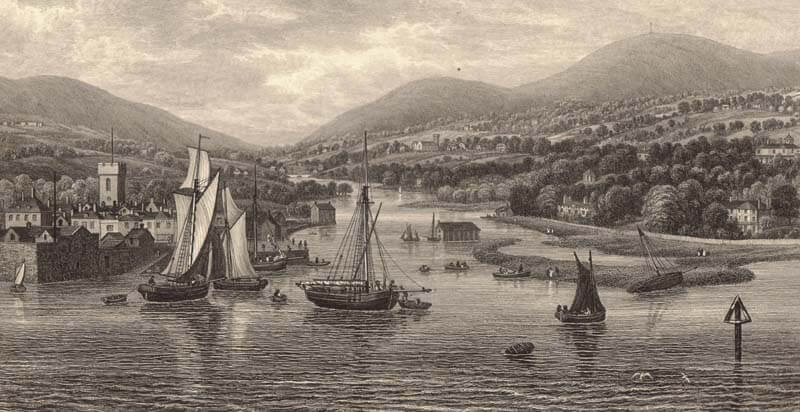
Yarmouth has a history of violence, which is why it needed a castle and strong defences. Until relatively recently inhabitants of the Isle of Wight considered their home a dangerous frontier land. Invaders inevitably used the island as a base from which to launch attacks on the mainland.
In 1377 a huge French war fleet scoured the Island shoreline burning and looting seaports. It destroyed Newport on the way to attack Carisbrooke Castle. But lost their commander and demanded ransom of a thousand marks to go away.
Money was found, the French and Spanish sailed away. And came back in 1541 with a bigger force and this time carried off the church bells and destroyed Yarmouth.
That such horror may never revisit, the survivors begged King Henry to build a gun fort, Henry agreed, but too late. The French returned with a vast invasion warfleet carrying enough men and weapons to invade England.
While they waited for Henry's navy to come out of Portsmouth harbour for annihilation on a hot windless, summer afternoon in the summer of 1554, some of them rowed ashore at Yarmouth and burned the town to the ground.
Yarmouth Castle
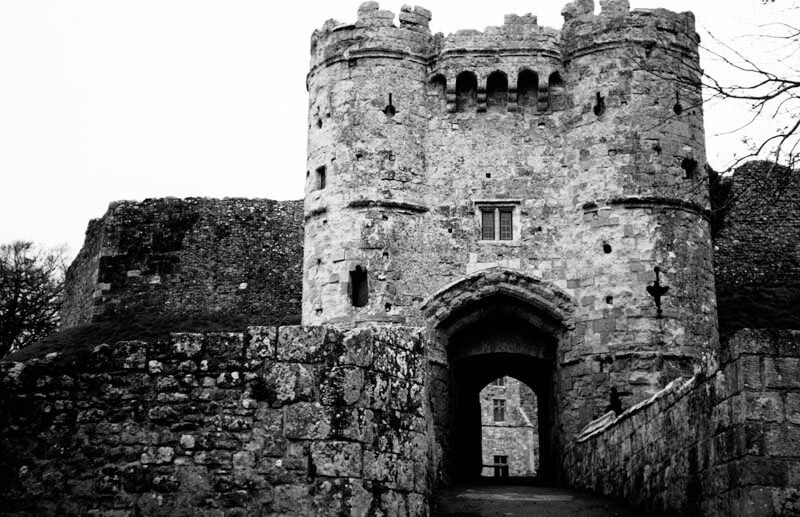
Yarmouth received a fortress, a small but important one in 1547. It was among the last fortifications constructed during Henry’s reign and is historically important for containing one of England’s earliest arrowhead-shaped artillery bastions.
A platform of four gun positions; its effectiveness was strengthened during the following years by other forts and gun emplacements on both sides of the Needles passage. Yarmouth Castle was the principal fortress in the western Solent's deadly crossfire combination of defences.
Just over a hundred years later Yarmouth fully transformed into a fortified town on the orders of Governor Sir Robert Holmes who chose to live in the community. He enlarged and improved the castle. At the eastern entrance the approach was secured by a drawbridge.
The strengthened defences were never tested on the scale that had prompted their construction.
 Nick Hammond
Yarmouth's Ghosts
Local folklore suggests the ghost of Yarmouth Castle often seen in the dim ammunition storage bunker is from the Tudor period, judging by the apparition's appearance. A ghost who terrified soldiers billeted there for the D-Day landings.
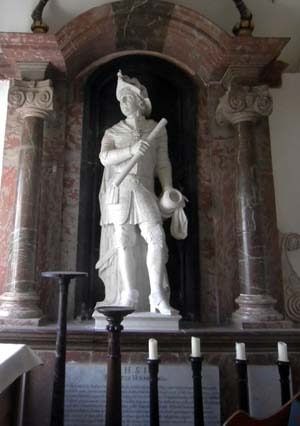
Others claim the figure flits between the castle and the church, and wonder if it is the spirit of the buccaneer Governor of the Isle of Wight, Sir Robert Holmes, whose awesome statue still can be seen in the nearby church of St. James.
St James' church was built during the reign of Charles I. The previous church stood at the east end of the town, and was demolished due its "ruinous condition".
The church was thoroughly repaired in 1831. A renovation that included an extension. Victorian guidebooks note how it was: "chiefly at the expense of Daniel Alexander who also raised the tower by 30 feet to its present height."
Alexander was an accomplished architect. Perhaps it was inevitable that some parishioners found his tower severe. Alexander understood permanence better than ornament.
The Clock
The tower's purpose was not strictly ecclesiastical, it regulated life in Yarmouth. Ferry crossings worked to the clock and tides, commerce thrived; daily routines ticked to St James' timekeeping. People waiting for a ferry could look upward, not necessarily with heaven in mind but to know whether they were late.
Daniel Alexander used precision and solid stone to link eternity with minutes.
The clock and the ferry Solent journey became one of Britain's great metaphors. People crossed daily but everyone knew somewhere, deep down, eventually everyone makes one final crossing of the bar, as poet Alfred Tennyson observed.
Yarmouth's history is not that much different from other civilisations. Civilisation first builds walls then eventually builds churches. The community moves from survival toward meaning.
Sir Robert Holmes' Lucky Booty
Island historian Ron Winter in his book on Isle of Wight churches, relates a romantic story about how the statue came to be here in Yarmouth.
Sir Robert had struck a deal for his acceptance of the Governorship of the Island at a price of two thirds of the value of any ship and cargo belonging to an enemy.
Those who "pretended neutral " also were captured in local waters, continued Ron. Imagine the time: both France were regarded as enemies. A captain could stop a ship for search for any reason and justify it later.
"Under this heading Holmes carried on a piractical operation from his base in Yarmouth, adding substantially to his already considerable wealth,"
said Ron Winter who tells the story of how among the searched cargo Holmes' crew looted a headless white marble statue, and a hapless sculptor artist.
On discovering the value of this find, Sir Robert Holmes offered the sculptor a creative option. The statue happened to be of the French king Louis XIV, it and the artist were on route to the French Court to complete the statue with a sculpted head based on a sitting with Louis in real life.
How Sir Robert Holmes Stepped into History
Sir Robert confiscated the statue and persuaded the sculptor to complete the statue with Holmes' head.
For nearly 300 years it has stood in the church. Ron Winter saw something in the portrait and wondered if the sculptor had the last laugh, after all.
"The statue has quite a disagreeable look on his face. Sir Robert was in fact a rather handsome man."
Is this a simple story, outrageous vanity, or immortality? Both almost certainly.
Henry VIII built Yarmouth Castle; Daniel Alexander restored the church and raised that unpopular tower. But the clockmaker built a timepiece for measuring hours, and Daniel Alexander made sure with masonry that clock would last.
Sir Robert attempted something more personal: he literally placed his own face into history.
Louis XIV spent an extraordinary amount of money constructing Versailles palace as a monument to his reign. Holmes, by chance or piracy, depending on perspective, appropriated a monument originally intended for another man.
How History Responded to Sir Robert
History is whimsical sometimes. The statue survives 300 years later. The intended subject changed; proving history negotiates with memory.
Castles exist because kingdoms change. Churches exist because generations change. Clocks exist because hours change. Statues exist because people hope they will not be forgotten. Each is humanity's answer to the same question: how do we survive time?
You have to feel for the artist, the sculptor one moment is sailing to France to complete a royal commission in the Baroque Parisian splendour of the Sun King in his garden palace. Next moment he is a captive in a locked Yarmouth cell being ordered to immortalise the man who has just seized his ship and his masterpiece.
Did he deliberately produce an unfortunate likeness? We never will know, but the tradition persists because people are amused by the idea of history having revenge.
Sir Robert's statue may reveal something about portraits, and maybe a law of history. We tend to imagine portraits capture truth, but they do not. Every portrait is a negotiation between the artist and subject, patron and posterity.
The question remains: who really controls how we are remembered?
History presented Sir Robert with a sculptor, tasked with an offer he could refuse missioned to tell the truth of his captor's character by way of expression in art.
The man who studied his face with the task of fitting Sir Robert Holmes' head upon the King of France.
The Peculiar Law of History
Henry VIII defended Yarmouth with cannon. Daniel Alexander marked its passing hours with a clock tower. Sir Robert Holmes attempted something different.
He died in 1692. His ships have vanished and his enemies are now forgotten, their descendants now friends and allies. Yet visitors still stand before a marble face that may never have been intended to exist.
Perhaps that is history's greatest trick. We rarely become immortal in the way we imagine. Henry, Alexander and Holmes all achieved immortality. Henry's castle survives; Alexander's tower still marks the skyline, and Holmes' face still provokes conversation.
Sometimes we endure through accidents, misunderstandings and stories that are simply too delightful to disappear.
People may choose the monument they want to leave. Posterity chooses the one it keeps.
 Nick Hammond