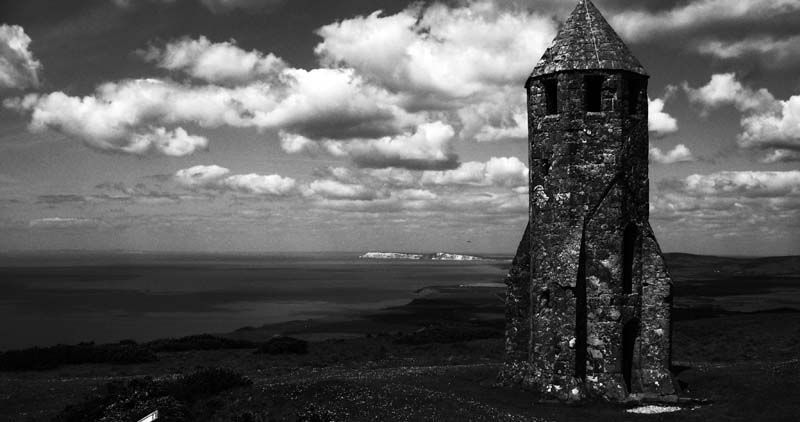
Most monuments are built with a purpose, to defend a kingdom, honour the dead or guide ships home. St. Catherine's Tower does none of these anymore. 700 years later it remains one of the Island's most recognised landmarks. Why?
Can Repentance Outlive a Sinner?
Even before this tower was built, long ago, a hermit had chosen this high lonely place; an isolationist named Walter de Langstrell lived here. We do not know exactly why he came, only that he believed this high place was worth dedicating his life to.
He was the first of many.
The monumental tower that stands here today is the last of Britain's medieval lighthouses. It was built in 1321 paid for by wealthy local landowner Sir Walter de Godeton who lived in a valley below the hill, what is now Gotten Manor.
Sir Walter's seeming good fortune on receiving a cargo of wine from the wreck of the St Marie de Bayonne off the shore below was spoiled when his holiness the pope noticed the hole in his inventory and discovered the beneficiary.
The pope sent a strongly worded message warning De Godeton of the dire spiritual danger he now had placed upon his own soul. And suggested a restorative penance for depriving a thirsty Catholic monastery of that cargo.
De Godeton may have sighed with relief at salvation but accepted the cost of constructing a lighthouse. In addition he built an adjoining chapel on the site of Langstrell's hermitage for when the mist was thick and the light failed to shine, a priest could pray for those poor souls lost below in the notorious ship-destroying ‘Bay of Death’.
Perhaps de Godeton believed the pope's assurance that one lasting act of repentance could outlive both the sin and the sinner. By building something permanent, he hoped to redeem one irreversible mistake.
The High House of Prayer and Light
For two centuries the lighthouse pursued its purpose to prevent wrecks. The adjoining chapel existed for those the light could not save. We have no idea how effective this pairing of technology and prayer worked together, how many ships and souls were saved during that period.
When Henry VIII dissolved the religious houses St. Catherine's fortunes changed. The prayers stopped, the priest was evicted and before long the chapel disappeared.
But the tower was spared even though its biggest problem was obvious. The lighthouse worked, except when mariners needed it most.
Mist often shrouded St. Catherine's high headland.
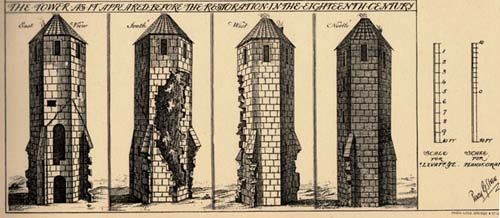
Sir Richard Worsley's Opinion on the Tower.
St. Catherine's Tower stands seven hundred and fifty feet (228 m.) above sea level. Sir Richard Worsley noted in 1781 in his History of the Isle of Wight:
"It is 'thirty five feet six inches high (10.8 m.), octangular without and quadrangular within, each side interior as well as exterior being exactly four feet (1.2 m.).
From this construction the curious have found out some resemblance to the temple of the eight winds at Athens, a building it is more than probable the architect never saw, or ever heard of."
That Classical and mythological opinion may or may not be true.
 Nick Hammond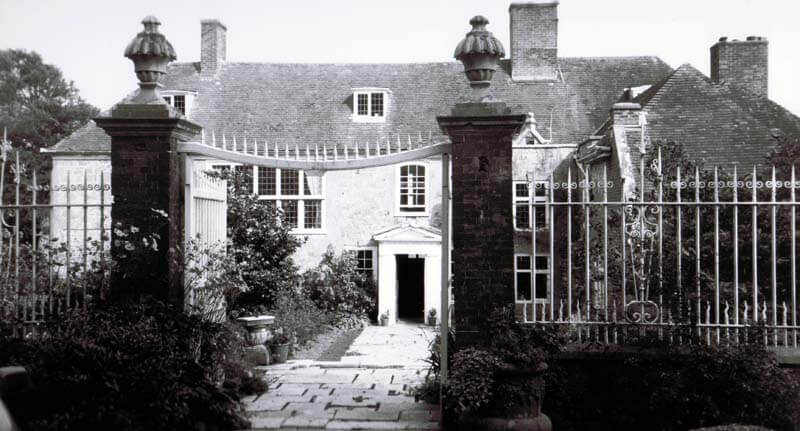
The Ghost of St. Catherine's Tower
The original lantern is lost, the chapel removed; Walter de Godeton and the monks he supported are long gone, their prayers silenced. Yet people still claim to see a light shining in the old light tower.
History rarely preserves monuments unchanged, it rewrites their meaning. It now is a haunted tower.
Tradition speculates that it is either Sir Walter still paying off his penance; or de Langstrell who refuses to abandon his mission.
Or we may wonder exactly which slice of time has remained caught upon the tower, or what faces can be seen in the seaborne mist. Its ghost could be from any part of this monument's long history. Or folklore.
St Catherine's tower is a lighthouse that became a landmark. Built to be seen from the sea it is now climbed for the view across it.
Its relationship to the world has reversed. Even the direction in which the monument speaks has changed.
The Monumental Pair
St Catherine's tower is different to most other of the Isle of Wight's monuments. Appuldurcombe celebrates wealth; Osborne House celebrates empire; Tennyson's monument celebrates genius; Quarr celebrates religious devotion. Each in their own way is built to celebrate success.
St. Catherine's Tower exists because of failure. It was built because a wealthy man made a morally dubious decision after a shipwreck. Its entire existence begins with human imperfection.
The monument wasn't built to celebrate Walter de Godeton, it was built to correct him. Yet today it has become his memorial anyway. History has reversed its meaning as well as its direction of intent.
Four centuries later it gained a companion.
St Catherine's Tower was not the last attempt to leave something permanent upon this chalk skyline. Four centuries later Michael Hoy looked up from Gotten Manor and decided he too would raise stone upon the skyline.
His monument celebrated the visit of Tsar Alexander I. When Hoy was gone and Gotten acquired a new owner, W.H. Dawes transformed it into a memorial to the fallen of Sevastopol.
Walter's memorial, the oratory tower, remembered repentance. Hoy remembered the Russians; and Dawes remembered sacrifice in war.
Today, people mostly remember both monuments with nicknames: "The Pepper Pot" and "The Vinegar Bottle".
 Nick Hammond
History Has its Own Priorities
They are now part of the Island's identity. The people who raised them hoped to shape the future. Instead, the future quietly reshaped them.
Every generation believes it can decide what posterity will remember.
Some castles become ruins; some abbeys become farms; some mansions become shells. Some lighthouses cease to shine. Some ghost stories outlive the people who first told them.
Places become archives. They do not preserve everything, only just enough for each generation to reinterpret the past.
These facing monuments are a poignant pair. One no longer guides ships, the other no longer commemorates what its builder intended.
De Godeton, Hoy and Dawes each believed they understood what future generations should remember. Their original meanings faded but the monuments remained, becoming landmarks, viewpoints, local curiosities and subjects of folklore.
History quietly rewrote them all. Their nicknames almost complete the story.
The Pepper Pot and the Vinegar Bottle
Perhaps that is the strange fate of every monument. We build them for one reason, but time rarely preserves that reason unchanged. It preserves the stone, then allows each generation to discover a different meaning within it.
The lighthouse didn't lose its purpose entirely. It acquired new ones. It ceased to guide ships; it became a landmark; then a historical monument. It became a symbol of medieval penance. It has become a setting for ghost stories.
St. Catherine's Tower lost the purpose its builder intended, but gained purposes they could never have imagined.
History rarely preserves intention. It preserves possibility.