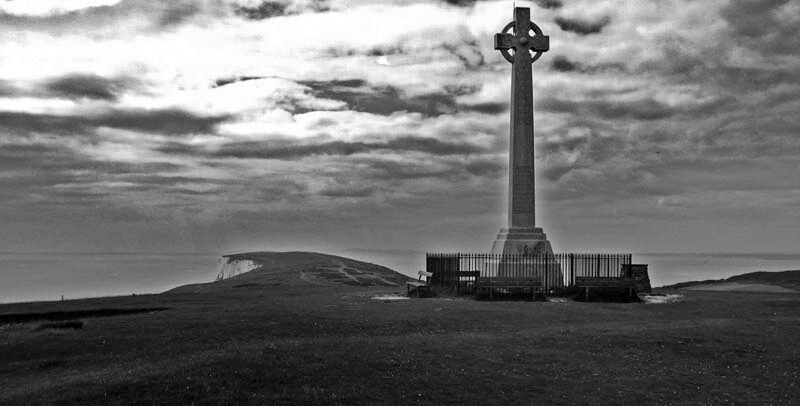
Can we choose what the future remembers? The granite Tennyson Monument on High Down may survive for centuries. But can a monument still preserve a poet's legacy in the digital age?
The Ghost Ambush
Long before Alfred Lord Tennyson looked westward from these chalk cliffs, people climbed High Down carrying their dead. Later generations carried firewood for a beacon. The Victorians carried stone for a memorial.
Today some visitors claim something else still walks this ridge. The ghost of Alfred Tennyson.
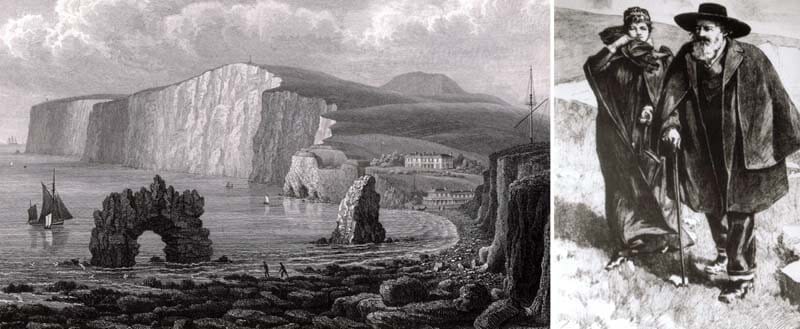
Donald Parr in his book Ghosts of Hampshire and the Isle of Wight, records one of the Island's most dramatic ghostly experiences, when a group of Freshwater villagers attempted to ambush a figure roaming High Down dressed in the poet's favourite outfit of cape and big hat.
The ghost literally walked into and through the trap, and everyone saw.
Perhaps the landscape contributed as much to the experience as the reported figure. The site of the ambush is a place of immense skies and sheer cliffs. High Down feels detached from ordinary life.
Beacons before the Beacon
High Down already was ancient when Tennyson and his family arrived on the Island in 1853. Along the ridge lie Bronze Age barrows and prehistoric burial monuments.
Thousands of years before anyone thought of building churches or monuments, people climbed this exposed summit to bury their dead beneath the open sky.
We cannot know exactly why.
Long before the white granite cross appeared, another beacon stood here. Signal fires linked the Island's highest points into England's defensive network. When invasion threatened, flames on High Down carried warnings across the Solent and along the coast.
When Alfred Tennyson died in 1892, Islanders chose almost the exact location for his memorial. The medieval beacon's fire and smoke was replaced by a Victorian beacon carrying Tennyson's voice and poetry across generations.
Tennyson and Time
Standing beside the cross, the landscape unfolds almost like a history book. To the west lie the Needles Rocks, beyond them once stretched dry land.
During the last Ice Age, people could have walked from what is now the Isle of Wight directly into Dorset. Rising seas eventually drowned that landscape and cut the Island away from Britain.
Everything visible from the monument has since changed. The coastline, its forests, environmental climate; even the shape of the land.
This was a place where the poet liked to walk, finding inspiration for his reflections on love and loss, and the passing of time.
Today, visitors bring cameras and picnic baskets, and some claim to glimpse a ghostly figure in big hat and green cape.
 Nick Hammond
Can We Choose What the Future Remembers?
The people who erected the monument in 1897 had a clear intention. They wanted future generations to remember Alfred Tennyson. They chose a commanding position where the monument could be seen for miles, echoing the old beacon site.
They built it of granite because they wanted permanence.
Consider the prehistoric barrows a few hundred metres distant. The people who built them undoubtedly knew exactly what they meant. Knew whose remains lay within them, what ceremonies had taken place there and what beliefs the monuments expressed.
Five thousand years later the monuments have survived but their meaning largely did not. Stone preserves structure far better than it preserves intentions.
Every generation believes its own monuments will be the exception. The builders of the barrows succeeded physically but their intellectual world became inaccessible. The same question hangs over the Tennyson monument. Will it still stand in five thousand years?
Perhaps. Granite is remarkably durable. But even if it does will anyone remember who Alfred Tennyson was? Or why Victorians thought him worthy of a 50 foot cross. Or even that it was a memorial and not a religious monument.
Nobody can know.
Tennyson's poetry explored these issues: the permanence of mortality, change and the passage of time. The monument attempts to solve the problem he wrote about. The Victorians answered his poetry by saying in stone: "We cannot prevent death, but we can prevent forgetting."
The Monument and the Barrows
The barrows are anonymous, the monument is named. Usually we assume names preserve memory better than anonymity. Perhaps the opposite sometimes happens.
The anonymous barrows continue to fascinate because we no longer know their story.
The Tennyson monument by contrast seems straightforward. "It commemorates Alfred Tennyson". But will that apparent certainty survive 5000 years? Or will future archaeologists stand underneath it wondering "Who was Alfred Tennyson?" and "What did these people believe?"
Exactly the questions we now ask of the Bronze Age.
Every monument is an act of faith. Its builders believe they can speak to people they will never meet. Every civilisation builds monuments believing it can communicate with the future. Whether the future understands is never entirely within its control.
Tennyson's Poetry
Tennyson wrote about memory and mortality. In In Memoriam. A.H. H. he addressed the pain of grief.
"Tis better to have loved and lost
Than never to have loved at all."
A line now almost detached from its context, but the poem explores how memory survives loss. Love survives death, but how long can memory survive the passage of time?
High Down has served as different kinds of beacon. A prehistoric beacon of ancestry, where communities remembered their dead through barrows. A medieval beacon of warning, where fire carried urgent messages across the landscape. A Victorian beacon of ideas on being human.
Perhaps High Down's ghost story is another form of beacon.
Multitude of Reflections on a Universal Message
Tennyson belonged to a culture with relatively few shared voices. Today we inhabit a culture with almost unlimited voices.
Victorians often knew Tennyson because there were comparatively few writers who occupied such a dominant place in public life. His poems were quoted in newspapers and taught in school lessons; quoted in church sermons and even public ceremonies. Tennyson was part of a common cultural vocabulary.
Today, our cultural landscape is radically different. We have access to Shakespeare and Tennyson, and Maya Anjelou. We have music and song lyrics on demand; podcasts, novels, YouTube, Instagram, TikTok, AI-generated writing and countless other sources of reflection.
The enormous expansion of competing voices has changed Tennyson's position. He no longer stands on the highest hill. He is one remarkable voice among millions.
The monument was designed to resist weather; granite erodes so slowly, on the scale of a human lifetime it appears almost permanent. Cultural memory erodes like conversation gradually moving elsewhere.
Today we preserve memory differently. A teenager may never visit High Down, yet they can encounter Tennyson on a website, a digital archive, an audio book or even through a quotation shared on line. It fragments attention but also makes forgotten voices globally accessible.
The monument may become less important as the primary carrier of his memory, even while Tennyson's work remains available to more people than ever before.
Tennyson's Message to the Now
Every generation builds its monuments in the materials it most trusts. The Bronze Age chose earth; medieval England chose fire; Victorian Britain chose granite. We increasingly build our monuments with data.
Our memorials are no longer always raised on hills. Sometimes they exist on servers scattered across the world.
The cross will not last forever. Wind and rain will eventually claim it, just as they claimed the vanished land bridge beyond the Needles.
Tennyson's poetry may ultimately outlive the monument erected to honour it. We who live now will never know which lasts longer, granite, poetry or memory?
Tennyson might have answered differently. He spent his life building a monument from words.
In Ulysses, looking westward over the sea he wrote:
"To strive, to seek, to find, and not to yield."
The Victorians built a monument to ensure Tennyson would not be forgotten. More than a century later, it has become part of the experiment, asking us whether commemoration works at all.
The medieval beacon existed to transmit urgent messages across distance. The Tennyson monument exists to transmit memory across time. One hoped someone far away would understand. The other hopes someone far in the future still will.
Whether a message is received depends upon someone looking in the right direction at the right moment.
 Nick Hammond