Perhaps the island's oldest town, Brading boasts three very dark events, but from which of these comes the Old Rectory Mansion's notorious ghost?
What does a community choose to carry forward from its past, and why?
Brading has chosen to preserve a haunted house, a whipping post, a forgotten skeleton and stories of ghosts. Each remembers something different.
Brading town council has not preserved the town's stocks and whipping post because it wishes public humiliation would return. They are preserved because forgetting them would risk misunderstanding the society that created them.
A medieval whipping post tells us something uncomfortable: justice once happened in public.
Punishment was intended to be seen; shame was part of the sentence.
Today, justice is largely hidden behind courtroom doors and prison walls. The instruments therefore remind us of what people did in the medieval past, and how differently society once understood crime in the community and how authority should respond.
The objects have become historical documents.
How and What a Town Remembers
People forget; buildings often do not. In its ghost story the Old Rectory remembers travellers. The church of St. Mary remembers burials. Brading's town hall remembers justice.
Each building preserves a different layer of this ancient town's collective memory.
Why display these instruments of suffering? Because removing them does not remove the history.
The same argument is made for preserving battlefields and concentration camps.
They remind later generations that terrible things happened, and that ordinary people once regarded those things as acceptable.
Objects outlive ideas.
The stocks have survived. The beliefs that justified them have largely disappeared. The object therefore becomes a fossil of an extinct moral world. Just as archaeologists uncover Roman pottery to understand Roman life, historians study punishment devices to understand medieval ideas of justice.
Perhaps ghost stories survive for the same reason these objects survive. Neither is preserved because we can prove every detail. They endure because communities continue to find meaning in them.
Three Dark Stories
Brading has some fascinating real life and death murder mysteries. One surfaced along with a skeleton found underneath the floorboards in the Old Rectory Mansion.
The second is documented, literally in the history of the Church, a mass unaliving event that swept across the Island, and probably started in Brading.
The third murder-mystery is more folklore than fact, and sprang to life when Brading Haven was drained and an old well was revealed in the mud.
Paranormalists wonder if the ghost of the Old Rectory Mansion is linked to one of these events, but which is the mystery.
Skeleton Found in the Old Rectory
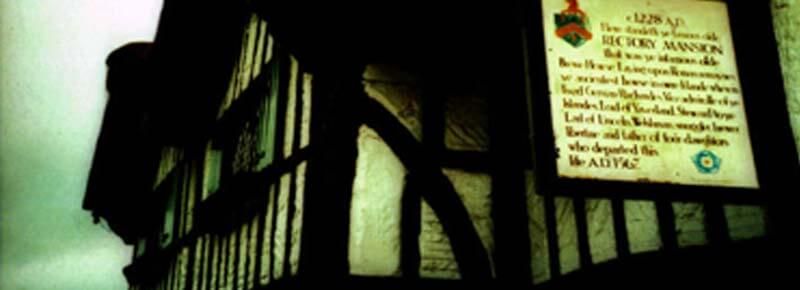
The Old Rectory Mansion, Brading's landmark historic building stands at the top of the high street, neighbouring the church of St Mary the Virgin. The Old Rectory is among the Isle of Wight’s most famously haunted buildings.
Local folklore claims it is haunted by a foreign ghost, the spirit of an unlucky Frenchman who cursed the house until his bones were returned to his native land.
When, in the 1960s during renovation work, a skeleton was unearthed under the floor, everyone naturally assumed Louis de Rochefort was found and his remains could be repatriated, and so cure the curse. The bones were shipped back to France, their homecoming announced in the national press.
Unfortunately no one wanted them; the remains were brought back to Brading, and some residents believe this rejection made the haunting worse.
Louis de Rochefort
Many intrepid ghost-hunters have ventured to stay the night in this building; one room in particular in the white and black timbered wing. They tell of ghostly footsteps, rattling handles and terrifying screams.
Some report sightings of a tall figure gliding through the wall into the room. At such moments the name Louis de Rochefort is whispered.
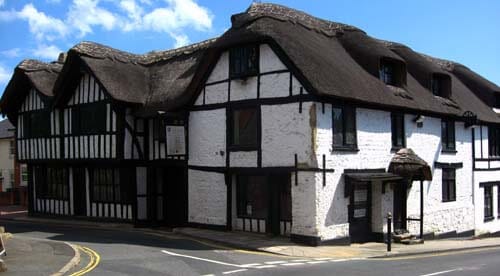
According to Brading legend a homicide happened here one night in the 1640s during the reign of King Charles I.
Since Tudor times it housed a quay-side inn and its rooms, formerly the Old Rectory Mansion, were used for accommodation of every variety.
The victim is believed to have come from France; he ate a meal here, drank wine and then retired upstairs to the bedroom overlooking the church. Later that night as he slept, someone entered the chamber and drove a knife into his chest.
With his dying breath he cursed the Old Rectory if they didn't send him home.
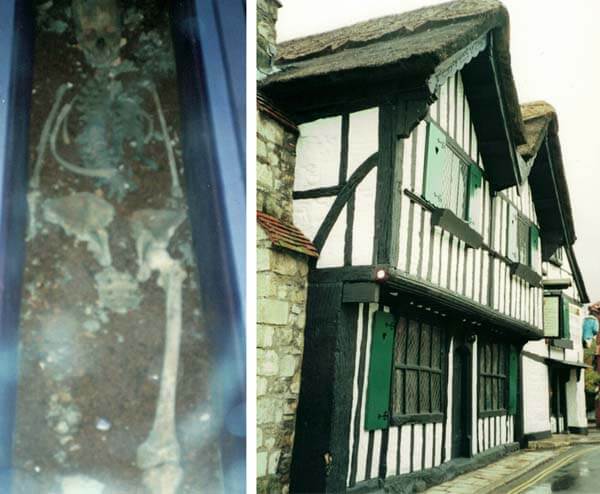
France did not want him. Louis came back to the Old Rectory Mansion, laid in display in a glass-topped coffin resting in French soil to keep him quiet.
But he would not rest, for many residents and visitors heard the floorboards creak with ghostly footstep and assumed Louis’ supernatural sulk had resumed.
King Caedwalla's Massacre
Most paranormalists assume the ghost of the Old Rectory Mansion is Louis, because violently interrupted life tends to cause the unhappy undead.
But poor Louis may not have been the first homicide in Brading. Early church chronicles preserve the memory of a far greater tragedy that probably started in Brading Haven.
No one imagines there are ghosts from that incident haunting the Old Rectory. That the supernatural activity is caused by the brave spirit of Saint Wilfrid who chose to remain as spiritual sentry, to guard against any relapse of the Island's inhabitants back into their unGodly ways of idol-worship.
Or King Caedwalla who led an army into the Isle of Wight and massacred much of its population.
The Venerable Bede, a renowned scholar compiled an ecclesiastical history of the English people and published it in CE 781. Bede entered a record for the year 687 during the time when Saint Wilfrid lived in the neighbourhood and supported the work of a Saxon warlord named Caedwalla.
The entry includes the following reference:
'...Caedwalla subdued the Isle of Wight; and he sought to exterminate the natives by a terrible slaughter."
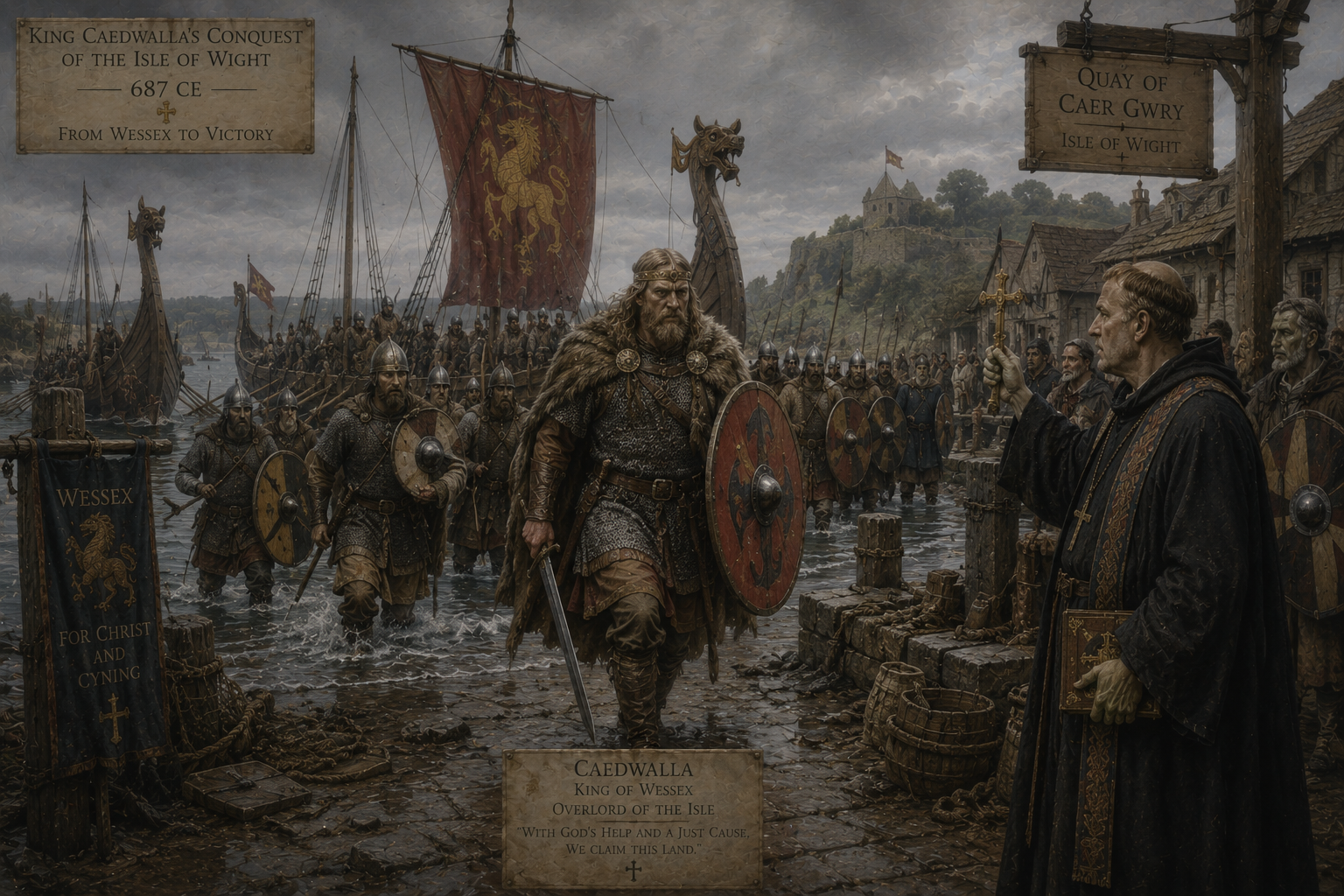
Those who have seen the ghost of the Old Rectory Mansion describe a disdainful "aristocratic figure" gliding through walls. Even though he was a king, Caedwalla is unlikely to fit that description. Nor Wilfrid who dressed in bishopric robes and is known to have adopted a tonsured haircut of a wide bald circle from ear to ear.
The Well & the Ruin of Sir Bevis Thelwall
Some paranormalists wonder if the ghostly aristocratic figure is the frustrated spirit of Sir Bevis Thelwell, the man who first drained Brading Haven.
During the summer of 1609, granted permission by King James I, Sir Bevis struck a deal with Sir Hugh Myddleton to employ a small army of Dutch groundsworkers to construct a sea defence and drain the Haven.
For a while that defence held, and the workers were paid. The huge muddy project cost £6,000; a lot in those days. Unfortunately a storm struck the Island, the wall sprang a leak and Sir Bevis was ruined.
For all that money and trouble all Bevis and the Brading residents found was ground too salted for planting, and a stone well. "Roman," guessed the local historians. "Druid," said the mystics of Brading.
Which inspired perhaps Brading's darkest story of all, though this may be entirely fiction.
According to Victorian folklorist Abraham Elder, in his collection of Tales of the Isle of Wight, the well was evidence that Brading was the Isle of Wight druids' sacred site, rivalled only by the Pillars of Ur, the great Needles Rocks at the far end of the chalk spine traversing the Island now known as the Needles.
Elder described the scene of Brading's dim and very distant past: the annual druid party at Brading well. A feast of druid delicacies, mistletoe and interesting pyrotechnics as the main event.
Who Haunts the Old Rectory Mansion?
Four centuries after Louis de Rochefort supposedly uttered his curse, visitors still report footsteps on empty floors, rattling handles and a figure crossing impossible walls.
Whether the haunting belongs to a murdered traveller, victims of conquest, forgotten burials beneath Brading, or simply to the imagination that old places inspire, the Old Rectory Mansion continues to resist explanation.
Like Brading the oldest town on the Isle of Wight, every answer uncovers another mystery beneath it.
 Nick Hammond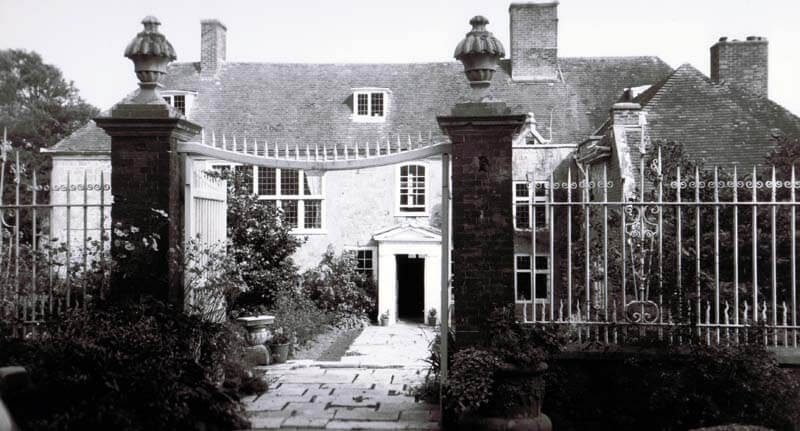
On What We Choose to Remember
People forget; buildings often remember. The Old Rectory remembers an unlucky Frenchman. The church next door remembers its dead, and perhaps the Island's worst human disaster. The town hall remembers justice.
Each preserves a layer of Brading's memory.
Maybe ghost stories survive for the same reason these objects survive. They endure because communities continue to find meaning in them.
One preserves emotional memory. The other preserves physical memory. Both ask us to remember.
The skeleton beneath the Old Rectory was discovered by accident. The stocks beneath the Town Hall have been preserved deliberately. One asks, "Who was this?" The other asks, "Who were we?"
Perhaps that is why Brading's ghost stories still matter. Whether or not the dead truly linger, the town has chosen what it refuses to forget.
 Nick Hammond