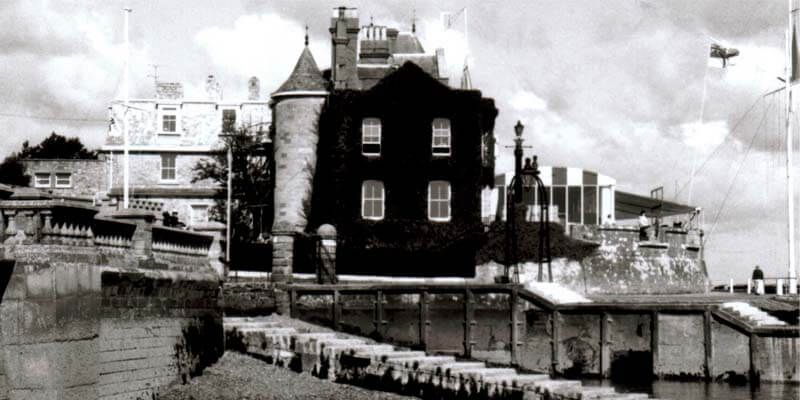
Sensitive staff in Cowes' famous Royal Yacht Squadron claim there's a ghost in the basement kitchen. And a second up in the clubhouse room.
Cowes Castle
The Royal Yacht Squadron in Cowes occupies one of the Isle of Wight’s most historically layered coastal sites.
Better known for royalty, sailing, and naval prestige than overt ghost stories, the building and its surroundings possess a quieter but persistent paranormal folklore rooted in military history and Victorian mourning culture.
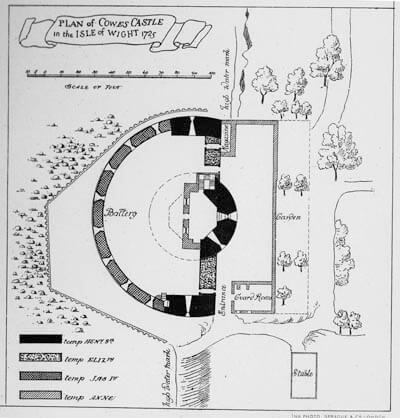
The Squadron was founded in 1815 and established itself within the former Cowes Castle, an artillery fort originally built by Henry VIII in 1539 as part of his chain of coastal defences against invasion from France and the Holy Roman Empire.
The castle overlooked the Solent, a waterway long associated with naval warfare, and centuries of maritime history.
Ghost on the Battlements
From a paranormal perspective, the setting is important. British coastal forts and naval buildings often develop ghost traditions because they stand at boundaries, the liminal realm between land and sea, safety and danger.
And for so many, departure and loss.
Cowes Castle watched generations of sailors leave for voyages from which many never returned. Over time, local folklore absorbed this atmosphere of anticipation and mourning.
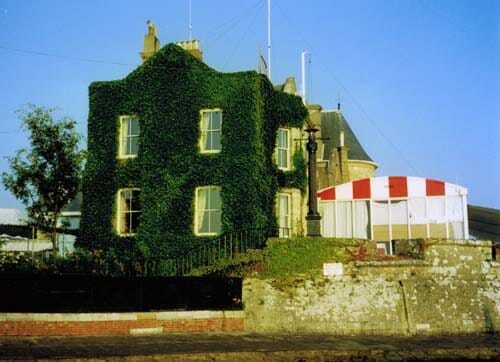
One recurring strand of Cowes folklore concerns phantom figures seen on the battlements overlooking the Solent.
Accounts vary, but witnesses have occasionally described shadowy naval-looking figures standing motionless near the old castle walls, especially in poor weather or sea mist.
In some stories, the figures vanish when approached. These tales may partly derive from the site’s Tudor military origins and later naval associations.
Paranormalists suggest it might be the ghost of Captain Humphrey Turney, who commanded Cowes Castle at the beginning of the English Civil War, fired its first shots and was subsequently arrested by Parliamentary forces.
Others wonder if it is the ghost of hapless King Charles I who arrived at Cowes during the wet autumn of 1647 on his way to Carisbrooke, where he spent his last year before execution.
Some staff insist they saw the ghost of a woman in the upstairs clubhouse rooms.
The Haunted Kitchen
Squadron kitchen staff speak of frightening paranormal activity in the lower levels, especially the kitchen where a knife-drawer rattling poltergeist is loose in their basement realm.
Unexplained footsteps and sounds echo within older parts of the castle structure after events have ended for the night.
Staff and visitors over the years reportedly described hearing movement on staircases or doors opening and closing when rooms were empty.
Such experiences are common in old stone coastal buildings where wind, temperature shifts, and sea air produce strange acoustics, but in folklore they naturally became associated with lingering spirits.
Supernatural & the Sea
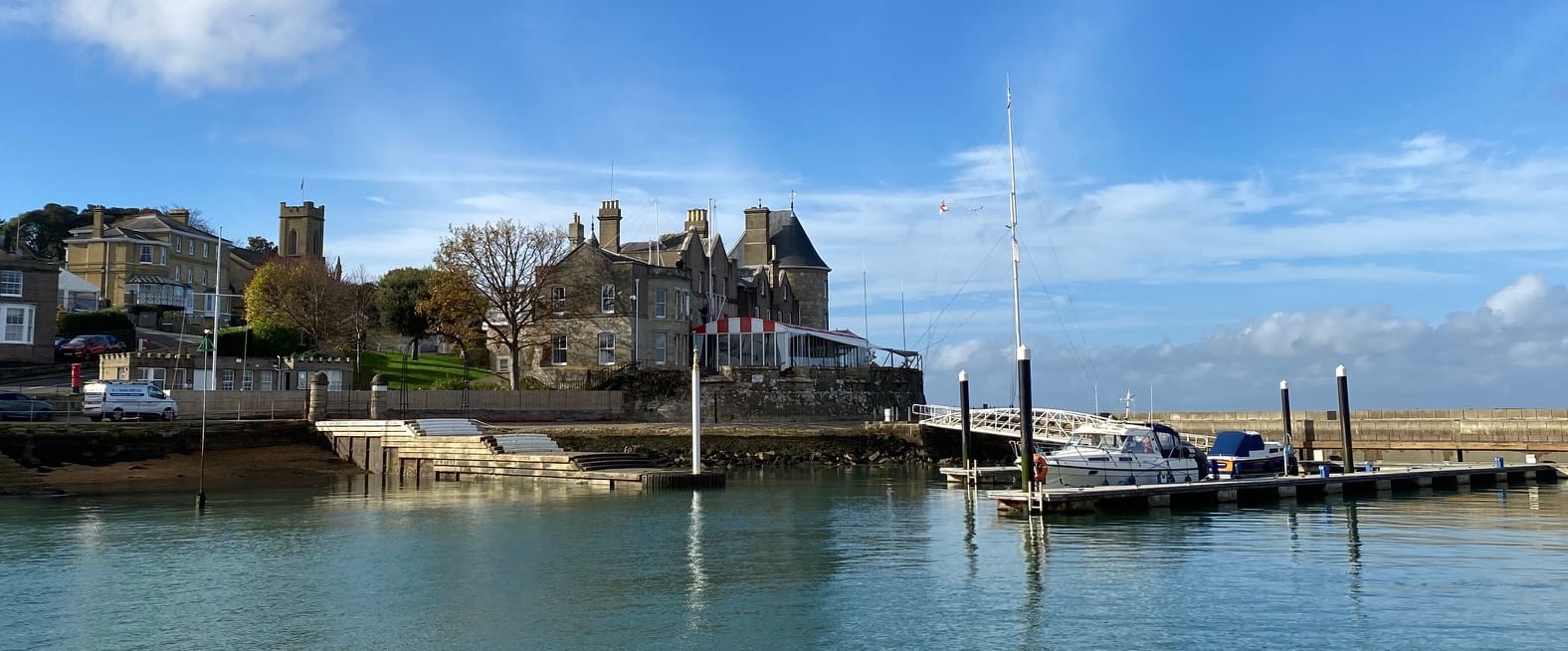
The sea dominates much of the paranormal storytelling around Cowes. Local maritime folklore contains tales of phantom ships, spectral lights, and drowned sailors along the Solent.
Some legends attached these phenomena loosely to the Squadron because of its symbolic role as the centre of elite British yachting.
Sailors have long been among the most superstitious professions, and Cowes inherited many of those traditions. Warnings about ghostly fogs and omens before races; tales of phnatom bells and apparitions connected to storms or shipwrecks.
The Cloud of Mourning
Victorian and Edwardian mourning culture also shaped the folklore.
During the 19th century, Cowes became closely associated with the royal family through Queen Victoria and nearby Osborne House. After Prince Albert’s death in 1861, Victoria’s prolonged grief deeply influenced the atmosphere of royal life on the Island.
Later storytelling sometimes linked Cowes’s old sailing society with an atmosphere of lingering melancholy and memory.
Some local tales even describe sightings of a dark-clothed Victorian woman near the waterfront during foggy evenings, occasionally interpreted romantically as a royal-associated apparition, though there is no evidence directly connecting such stories to Victoria herself.
High Society Ghosts
The Squadron’s exclusivity and traditions also encouraged mythmaking.
For generations it was a closed, aristocratic institution filled with portraits, naval relics, ceremonial uniforms, and memorials to lost sailors.
Buildings rich in ritual and continuity often acquire ghost stories because they preserve the emotional weight of the past so visibly.
A particularly persistent local theme concerns time-slips or “atmospheric hauntings.” Some visitors have described moments when the harbour seemed strangely silent or when they felt transported into an earlier maritime era while walking near the castle at dusk.
Folklorists would classify these more as experiential legends than traditional ghost sightings, moments where landscape and history combine to produce a sensation of historical overlap.
The wider area around Cowes contributes significantly to the folklore, particularly the Solent’s dangerous tides; wrecks and drownings and rich history of wartime naval activity.
Like many coastal ghost legends, stories attached to the Royal Yacht Squadron are less about dramatic apparitions and more about presence and atmosphere.
Modern paranormal literature on the Isle of Wight tends to focus more heavily on places like Appuldurcombe House or the old Royal National Hospital in Ventnor because they produce more vivid haunting narratives.
Yet the Royal Yacht Squadron occupies a subtler category of haunting folklore — one tied to maritime memory, naval ritual, and the uncanny mood of Britain’s historic southern coast.