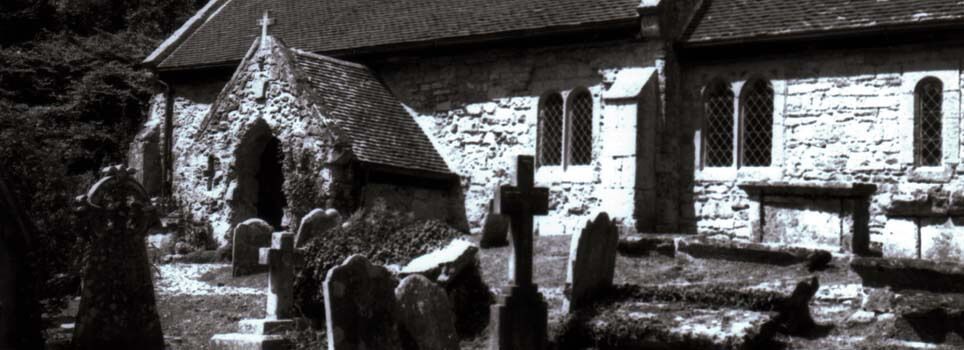
St Boniface church in Bonchurch is among the smallest in the Island. A ghost sometimes is glimpsed in the graveyard and another presence is felt, quite literally hands-on, inside the building.
The Church Among the Oaks
Bonchurch is one of the Isle of Wight’s most atmospheric and folkloric villages, a secluded place of ancient churches, hidden paths, landslip woodland and deep-rooted ghost traditions.
Tucked beneath steep cliffs close to Ventnor, Bonchurch has long carried a reputation for mystery and spiritual intensity.
From a paranormal perspective, the village is regarded as one of the Island’s more subtle realms, where a combination of ancient Christianity, Victorian spiritualism, and dramatic natural surroundings has created an enduring aura of haunting around the village.
The Ancient Sacred Origins
Bonchurch derives its name from the 8th-century missionary associated with Devon and Germany, Boniface, the second of two saints to visit the Isle of Wight.
In preparation for his mission work, during the early 700s, in the wilderness of continental Europe, Boniface ventured into this wild sea-swept region of the Undercliff. St Boniface,
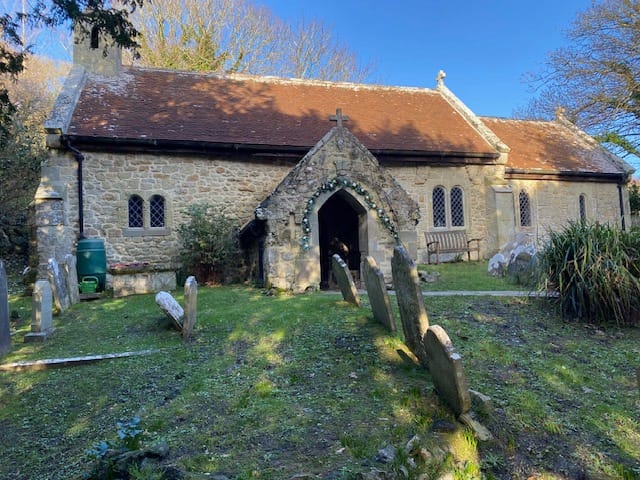
A church was founded in his honour, known as Boniface Old Church, one of the Isle of Wight’s oldest and most spiritually evocative on the Island.
Parts of the church date back to the 11th century, though tradition suggests a sacred site existed here much earlier.
According to legend Boniface found a prominent rock from which he preached to the fisher-folk; however, not until many centuries later was this church founded to commemorate that occasion.
The building is among the world’s smallest houses of God at a mere sixteen metres long, by four wide.
Boniface and the Oaks
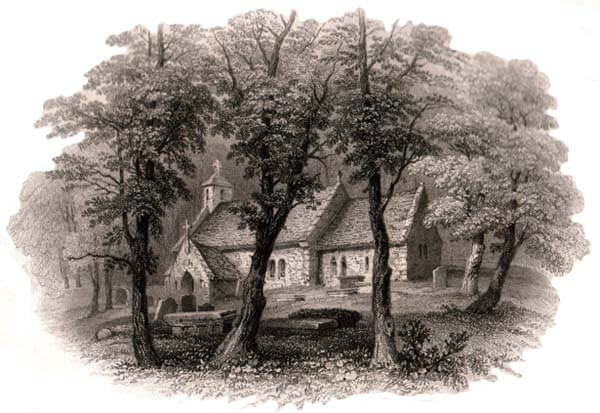
The vast hillside above is now dedicated to this brave saint’s memory, and Bonchurch residents of nature-friendly frame of mind note the happy, if strange, coincidence of the return of the oaks to Boniface Down.
For many years the hillside was bare, shorn smooth of forest, until someone not so long ago wandered up and down casting acorns as they walked and so the hill is forested. A few unhappy residents tried to shave it, but the trees have a hold now and the badgers and squirrels make a home.
The shore below is known as Monk's Bay, and ghost hunters come in search of ghostly clerics drifting up to the old church.
The churchyard’s ancient yew trees add greatly to the atmosphere. Across Britain, yews are strongly associated with cemetery spirits and sacred thresholds between worlds.
Many paranormal enthusiasts believe old yew-lined churchyards retain emotional or spiritual 'imprints' from centuries of burials and mourning rituals.
The Landslip and Hidden World Folklore
One of the most unusual features of the area is the Landslip, a tangled landscape of collapsed cliffs, wooded ravines and hidden pathways formed by ancient geological movement.
The landslip has inspired generations of supernatural stories because it feels physically separated from ordinary reality.
In folklore, such liminal landscapes often become associated with hidden spirits. Before the recent massive landslip carried away the section below the "Devil's Chimney" people who walked its ancient woodland and meandering paths sometimes spoke of strange sounds and figures glimpsed between trees.
Victorian visitors frequently described Bonchurch as dreamlike or enchanted, especially when sea mist drifted through the ravines.
Sceptics suggest the terrain itself contributes heavily to these impressions; it is a densely wooded landscape of distorted acoustics and sudden temperature changes. Its twisting pathways can create profound psychological unease.
Smugglers, Wreckers and Phantom Sailors
Like much of the southern Isle of Wight coast, the Landslip accumulated legends tied to smuggling and shipwrecks.
The secluded coves and hidden coastal routes made the area attractive to smugglers during the 18th and early 19th centuries. Folklore of lantern signals along cliffs, hidden contraband tunnels, and of course, stories of drowned sailors returning in spectral form.
The sea around Bonchurch has always possessed an unpredictable and dangerous character, feeding traditions of restless maritime spirits.
Charles Dickens and the Village’s Strange Reputation
Charles Dickens visited Bonchurch during the Victorian period and admired its atmosphere. The village became popular among writers, artists and spiritual seekers who were drawn to its secluded beauty.
Victorian fascination with séances and spiritualism added a new dimension to local ghost folklore, and helped reinforce Bonchurch’s supernatural reputation.
Many 19th-century visitors described the village in almost mystical language, describing it as timeless and enchanted. Such descriptions contributed to a cultural atmosphere where paranormal interpretation flourished naturally.
Apparitions and Local Ghost Stories
Bonchurch has accumulated ghost traditions over the years, most notably in the old church graveyard.
Reports of a woman in old-fashioned clothing, wandering the among the gravestones. Others have sensed, and sometimes even felt, quite literally a hands-on ghostly presence inside the church.
As with many old villages, the narrow lanes, dim lighting and irregular architecture naturally intensify these experiences.
The Healing Spring and Sacred Waters
Near the church lies the ancient Bonchurch spring, historically regarded as possessing healing qualities.
Pre-Christian sacred water traditions were frequently absorbed into Christian worship after conversion periods, meaning many holy wells may preserve echoes of far older spiritual beliefs.
Paranormal traditions often connect springs and underground water with psychic sensitivity and heightened emotional experiences.
Why Bonchurch Feels Haunted
Bonchurch’s atmosphere emerges from its isolation beneath towering cliffs, and ancient religious history. It is a realm of winding enclosed lanes and dense vegetation; into which roll sea mists.
Unlike dramatic castle hauntings, Bonchurch’s supernatural reputation is quieter and psychological. Visitors often describe an altered sense of time; the feeling of stepping into an older world.
Within Isle of Wight folklore, Bonchurch occupies a unique place, blending Christianity with older landscape mysticism. For paranormal enthusiasts, it is one of the Island’s most evocative locations because the supernatural here feels subtle rather than theatrical.
Many leave with the impression that Bonchurch is a place where memory itself lingers in the Landslip landscape; in the churchyard shadows, the sea mist, and the silence beneath the oak trees.
Exploring the haunted Isle of Wight